This guide is for the operating executive moving into a sponsor-backed company for the first time, the portfolio CEO or CFO going to the next one, the executive who wants to become an operating partner, and the large-company leader whose record has to be rewritten for a reader who does not care about scope.
Private equity is the most literal reader in the executive market. A sponsor has underwritten a return, has a date by which it needs to be realized, and reads your resume to decide one thing: whether you can move EBITDA inside that window. Everything in your document that does not answer that question is in the way. Most large-company executives arrive with a document that is almost entirely in the way.
Section 1 is the market, which has changed in a way that works in an operator's favour. Section 2 is why portfolio leaders get replaced, because you need to know the odds. Section 3 is how sponsors actually hire. Section 4 is what they read for. Section 5 is company types and sponsor temperament. Section 6 is compensation. Section 7 is the functional seats. Section 8 is the VC contrast. Section 9 is the mistakes, and Section 10 is the document standard. Where a number is from a report, the report is named. Where it is my framework from the work, I say so.
1. The market in 2026: the sponsor can no longer buy the return
Deal value recovered in 2025 and the first half of 2026 was rough, but the number that matters for an executive is older and structural. Bain's new deal math: in 2015 a sponsor needed about 5% annual EBITDA growth to make 2.5x in five years, because debt was half the price at 6 to 7% and the exit multiple did the rest. Today entry multiples are around 14x, debt is 30 to 40% of the price at 8 to 9%, and the same return needs 10 to 12% EBITDA growth a year. Multiple expansion drove more than half of buyout returns in the low-rate era. It will not now. The operator has to earn what the capital structure used to provide.
The numbers
- Global buyout deal value $904B in 2025, up 44%, on a falling deal count; average deal size a record $1.2B. Exits $717B, up 47%. Buyout fundraising down 16% (Bain Global Private Equity Report 2026).
- Roughly 32,000 unsold portfolio companies worth about $3.8T. Average hold at exit is about seven years against five to six in the prior decade; nearly 40% of companies have been held more than five years (Bain). McKinsey counts about 16,000 companies held four or more years, 52% of buyout inventory, and only 19% of 2021 acquisitions sold by 2025 against a historical 30%.
- Distributions are about 14% of net asset value, the lowest since 2008 to 2009, for the fourth straight year. 70% of limited partners name delayed exits their top concern (McKinsey LP survey).
- Continuation vehicles are now about 14% of sponsor-backed exits and GP-led secondaries reached $115B (McKinsey). A CEO may be re-underwritten by the same sponsor, which keeps the company for a second hold. That is a new career scenario and your documents should be ready for it.
- Bain's mid-2026 guidance to sponsors is explicit: refresh value-creation plans mid-hold and reset management incentives and talent where needed. Active portfolio counts have roughly doubled in a decade, so sponsors are triaging and concentrating resources on winners.
- Buyout returns are under pressure: 2022 to 2025 pooled buyout IRR 5.7%, and 53% of LPs now rank value creation a top-five criterion for choosing a sponsor (McKinsey). Leverage and multiple expansion were 59% of returns from 2010 to 2022. That share is gone.
Canada
H1 2026 Canadian private equity was $12.7B across 252 deals, with deal count down 24% and four take-privates (dentalcorp, ECN Capital, Information Services Corp, Blackline Safety) accounting for 57% of capital. Buyouts and add-ons were $8.4B across 52 transactions. Quebec led on deal count, Ontario on value, and the sponsors that matter most are often pension funds (CPPIB, La Caisse, OTPP, OMERS, BCI, PSP) that hold longer, co-invest, and lever less than US buyout shops. Exits were $10.8B across 33, led by Amica and the Apotex IPO (CVCA). The CVCA's own framing is that the mid-market, where most Canadian companies are built, is the opening.
What it means for you
Longer holds, harder math and a triaging sponsor add up to one thing: demand for executives who can produce double-digit EBITDA growth from operations, prove it quarterly, and be ready for an exit that may come at any time or not at all. The portfolio talent function, the operating partner and the Chief Transformation Officer exist because of this, and so does the replacement rate in the next section.
10 to 12% annual EBITDA growth is now the price of a 2.5x return.
Your resume is read as a forecast of whether you can deliver it. Write it that way.
2. Why portfolio leaders get replaced
Know the odds before you take the seat. They are why the document and the first hundred days matter so much.
- 65% of sponsors report replacing the CEO during the hold. Only 9% say they rarely do (AlixPartners 2026, 427 respondents). The older AlixPartners figure, 58% replaced within two years and 73% during the fund's life, dates from 2017 and still gets quoted. Bain's range is half to 70%. Spencer Stuart data: after a buyout, a new CEO is installed 70% of the time, and 75% of those come from outside. The HBR line, April 2026: more than half of PE-backed CEOs fail to meet expectations and are replaced.
- The reason is pace. 78% of sponsors name pace of change their biggest conflict with CEOs (AlixPartners), and AlixPartners' own read is that this typically refers to large corporate CEOs unused to mid-market pressure. The 2026 survey names misalignment on transformation pace, investment priorities, and success metrics as the driver.
- CFOs are replaced even more often. Sponsors retain only about a quarter of incumbent CFOs, usually replacing within 18 months; many companies cycle through two CFOs per hold; average tenure about 2.5 years (Accordion, vendor-cited). 97% of sponsors expect an always exit-ready CFO and 20% have one; 61% of CFOs switch to exit mode only when a sale window opens; rushed preparation can cost one to three turns of exit multiple (Accordion 2025, 400 respondents).
- Sponsors replace early. Heidrick's 2025 survey: when a team has exhausted its ability to unlock value, sponsors prefer changing leadership to extending the hold. Bain's guidance to reset talent mid-hold says the same thing from the other side.
- The best do the people work first. 97% of PE CEOs name assessing and upgrading the executive team a first-six-month priority; the best start searches within three months while the typical CEO waits 12 to 18 (Russell Reynolds). Tolerating early underperformance is read by sponsors as lack of resolve (Bain).
The first hundred days and the value-creation plan
Two documents run a sponsor-backed company. The 100-day plan is the first sprint after close: stabilize, assess, take the quick wins that are real, set the board cadence and the KPIs. It is finished by design. The value-creation plan is the multi-year blueprint it launches: three to eight levers, each mapped to a line in the EBITDA bridge with a named owner and an expected quarter of impact, reviewed quarterly, refreshed after the first year or it goes stale. The levers fall into six families: revenue (pricing, channel, mix, new segments), margin (procurement, SG&A, operations, technology spend), capital and cash (working capital, leverage, recap timing), talent (CEO and CFO transitions, key hires, organization, compensation), systems and data, and M&A (bolt-ons, platform expansion). The deal team drafts it from the investment memo; the operating partner refines it; the CEO and CFO deliver it. The successful plans have one operator who owns the bridge end to end.
Why this matters for your resume: the sponsor reads your record as evidence that you have owned a bridge like that before. Every bullet is a lever with a result. If your resume cannot be mapped to an EBITDA bridge, the sponsor cannot underwrite you.
Half to two-thirds of portfolio CEOs are replaced. Three in four CFOs.
The ones who survive move in the first hundred days, fix the team in the first three months, and report the bad news before the board asks.
3. How sponsors actually hire
The portfolio talent function
The first reader of your resume at a sponsor is increasingly a former search consultant who works inside the fund. Spencer Stuart reviewed 50 top-performing buyout and middle-market firms in 2025: 58% had a senior portfolio talent leader, up 20% in five years. Median team of three; 80% hire people with search or assessment backgrounds; leaders came from executive search (31%), in-house HR (21%), consulting (21%), and generalist roles (29%). They run five things: executive search and networks (they select and manage the search firms, and they track networks of executives for years before a role exists), leadership assessment, talent management and succession, operational support including interim executives, and pre-deal diligence, which Spencer Stuart calls talent underwriting. They spend 10 to 40% of their time pre-deal.
The implication: you can be in a sponsor's database two years before the seat exists, and a well-built, correctly worded profile is how you get there. Direct, confidential outreach to a talent partner with a one-page PE letter is a legitimate route and in my experience one of the most productive.
In-house operations groups
The largest sponsors run centralized operating teams: KKR Capstone (since around 2000), Blackstone Portfolio Operations (with sub-teams for talent, data and AI, procurement), TPG Ops (since 1995), Bain Capital's Portfolio Group (more than 115 operating professionals), Vista Consulting Group in software. Carlyle uses contracted senior advisers, 27 to 50 at a time, aligned to sector deal teams. Many lower-mid-market funds and nearly all independent sponsors have no operating function at all, which changes what they need from you (Section 5).
Operating partners
Five models in practice: the full-time generalist employed by the fund across two or three companies; the functional specialist (pricing, digital, supply chain, data); the interim executive placed as CEO or CFO until a permanent hire; the fractional or external operating partner engaged across funds, the fastest-growing model in the mid-market; and part-time senior advisers, who often have little real involvement. Base compensation is typically $300,000 to $500,000 at mid-market firms with fund carry, portfolio-company equity vesting on outcomes or deal bonuses; senior operating partners at large funds earn $1M to $3M including carry. Good ones are scarce and choose their firms. A CEO-in-residence is the pre-deal variant: an executive retained to diligence a thesis and step into the chair at close.
Search firms
Spencer Stuart, Heidrick, Korn Ferry, Russell Reynolds, and Egon Zehnder each run a private equity practice, and Spencer Stuart's is a primary conduit from public-company number-twos into PE CEO seats. A set of PE-focused boutiques (JM Search, Bespoke Partners in software, Hanold Associates for CHROs, Vardis, ECA Partners, and others) specialize. Remember the structure: inside a sponsor with a talent function, the search firm is a vendor to the talent partner, so being known to both is the goal.
Independent sponsors and search funds
More than 1,500 independent sponsors are active in the US, nearly double five years ago, and on one major deal platform they were 27% of closed deals in the year to October 2025, the largest buyer type (CapitalPad, compiling WhiteHorse and Axial data). Most target $2M to $10M of EBITDA. They have no operating team and often need an executive partner attached to the deal before capital providers commit. That is a distinct path for an operator with sector depth, and the letter for it is different: you are part of the thesis from the start. Search funds (681 formed since 1984, median searcher age 31, Stanford GSB) are a path for young searchers; seasoned executives enter as board members and mentors.
4. What a sponsor reads for
The citable criteria first, then the framework I use, labelled as mine.
What the data says
- Track record of success 73%, similar strategic challenges 55%, people leadership 48% are what sponsors weigh when hiring a CEO (AlixPartners).
- 45% of PE-backed CEOs were recruited for industry expertise, 33% were experienced PE CEOs, 31% cite prior PE experience as key to their hiring, and CEOs with prior CEO experience receive equity grants about 13% larger (Vardis 2025). The default, in ghSMART's words: when in doubt, choose somebody who has been the CEO of a PE-backed venture before. Talent shortages and more ambitious plans are pushing sponsors to recruit from corporate leadership anyway.
- Five capabilities for the corporate leader making the leap (ghSMART, HBR July 2026): practical commercial orientation; strategy under pressure; broad influence; willingness to take risk, especially on talent; wide interpersonal range. PE demands immediate value creation, lean execution, and direct, high-candour engagement with investors and boards.
- Five behaviours of the best PE-backed CEOs (HBR April 2026, two-year study): strategic clarity, talent alignment, relentless focus, disciplined execution through operating rhythms, and trust with accountability, embedded in systems so the company scales beyond the CEO.
- Search-firm language, consistent across sources: outcomes; how you achieved results as well as what; financial fluency in debt, EBITDA and capital efficiency; measurable wins in compressed timelines; relevant deal experience (integration, carve-outs); hands-on skills; speed to impact; candour with the board. Long, stable tenure can read as neutral or negative.
The vocabulary that is native to the sponsor
These are the units a sponsor already thinks in, which is why they belong on your resume and in your letter.
- EBITDA and the bridge: basis points of price, run-rate savings by spend line, days of working capital released. Every lever has a line.
- MOIC and IRR: 54% of management equity plans require 3 to 4x MOIC or the equivalent IRR for full vesting, and 78% use the same targets that secured the deal financing (Vardis). An executive who can write delivered 3.1x and 28% IRR at exit is speaking the sponsor's vesting language.
- Base case and underwriting case: the sponsor's reference model. 41% of executives reaching liquidity were paid below 75% of base case (Vardis). Against base case and against underwrite are legitimate comparators on a resume.
- Entry and exit multiple: a turn of multiple is the unit of exit-prep risk (Accordion). State both multiples in the context line of any role where you know them.
- Cash conversion, covenant headroom, 13-week cash: the CFO's native units, and the CEO's second language.
My framework: owned versus advised, and hold position
Two constructs of my own that every sponsor recognizes the moment they see them. Owned versus advised separates the P&L you carried from the one you influenced; a sponsor discounts advisory claims to zero, so the distinction has to be explicit in every role, including interim, consulting and operating-partner work. Hold position states when you arrived and left relative to entry and exit: at close, mid-hold, through exit, through transition. It tells the sponsor whether you have run to the clock, and it is the first thing a talent partner tries to work out from a resume that does not state it. The samples on the site show both on the context and scope lines.
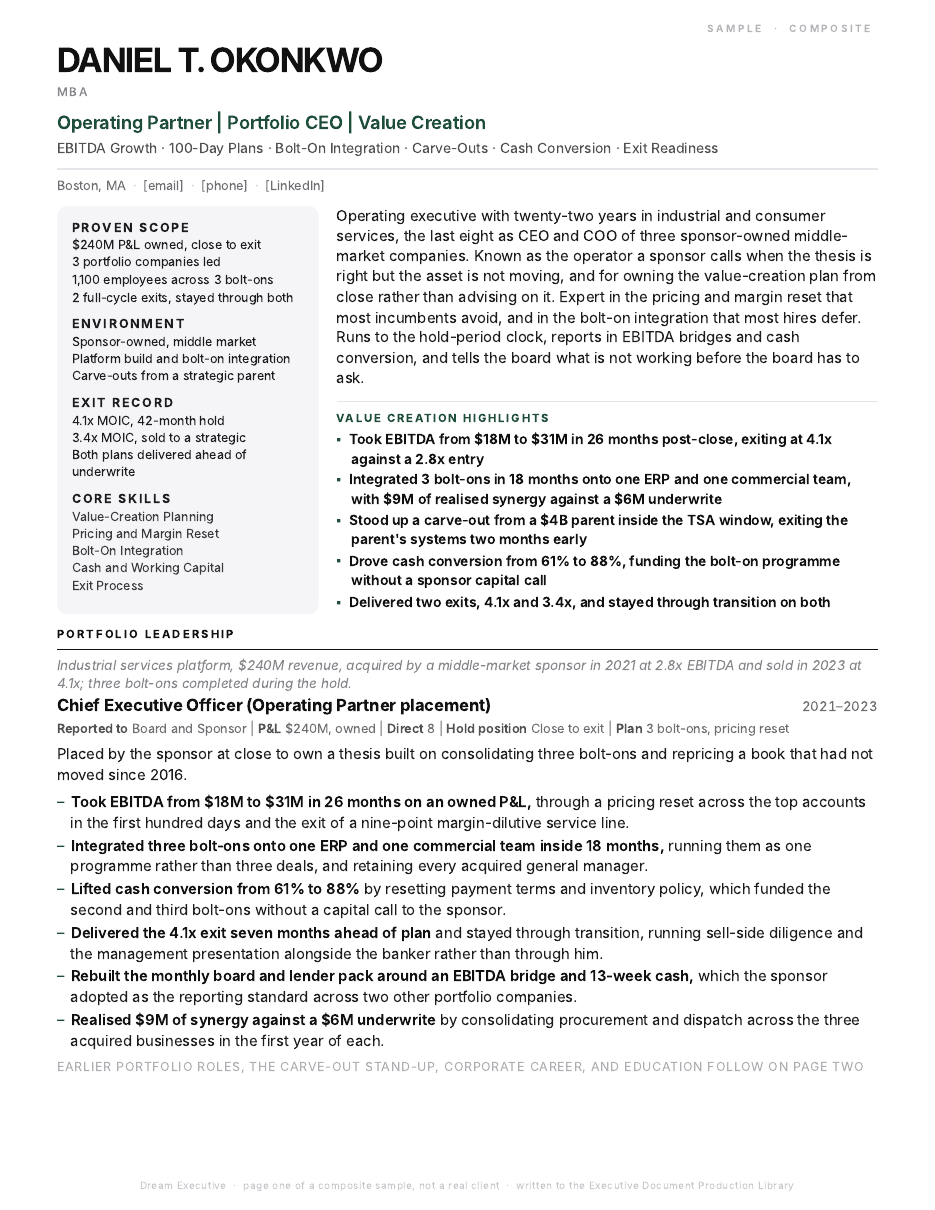
The context line, PE version. Industrial services, $240M revenue. Acquired by a middle-market sponsor in 2021 at 2.8x, exited 2023 at 4.1x. Arrived at close as the sponsor's placement.
Outcomes, levers, multiples, hold position, owned versus advised.
If the sponsor cannot map your record to an EBITDA bridge in thirty seconds, you are not on the list.
5. Company types and sponsor temperament
The same executive is read differently by a buyout sponsor with a 115-person operations group, a growth investor, an independent sponsor with no operating team, and a pension fund that will hold for a decade. Decide which reader you are writing for.
| Situation | What the sponsor needs from leadership | What your document leads with |
|---|---|---|
| Platform buyout | Own the VCP end to end; build the team; prove the bridge quarterly | EBITDA growth with the lever; hold position; team you built |
| Add-on and buy-and-build | Integrate fast onto one system and one commercial team; keep acquired leaders | Bolt-ons integrated, synergy against underwrite, retention |
| Carve-out | Stand up finance, IT and HR inside the TSA; opening balance sheet; cash visibility day one | TSA exit timing, run-rate versus one-time cost control, systems built not inherited |
| Take-private | Convert public reporting into sponsor reporting without missing a cycle; cost out; lender model | Public-to-sponsor transition owned; quality of earnings; covenant management |
| Founder-owned buyout | Professionalize without breaking what works; founder rollover relationship | First real planning cycle, first board pack, systems built, founder kept engaged |
| Growth equity (minority) | Growth first, path to profitability, minority-investor reporting | ARR or revenue trajectory, Rule of 40, capital efficiency |
| Turnaround and distressed | Cash first; stakeholder management with lenders; speed | 13-week cash, covenant resets, cost taken out in weeks |
| Infrastructure and pension-fund owned | Long hold, lower leverage, regulatory and stakeholder depth | Multi-year operating record, capital projects, regulator relationships |
Carve-outs deserve their own paragraph
A carve-out company may start with no finance team inside the perimeter and depend entirely on the seller for close, receivables, payables, and systems, under a transition services agreement the seller has no incentive to prioritize. FTI's description of the carve-out CFO is a dual mindset: strategic and operational, growth and cost, external and process. The phases are pre-close assessment, a compressed sign-to-close systems stand-up, the Day One opening balance sheet and cash visibility, and the TSA wind-down, when one-time costs ramp as run-rate costs begin. If you have done this, it is a highlight; sponsors are buying carve-outs precisely because the complexity is where the return is.
Sponsor temperament
Russell Reynolds' first lesson for portfolio CEOs is that not all PE firms are alike and neither are the people within them. The tells are structural. A sponsor with a centralized in-house operations group will bring playbooks, functional specialists, and data teams, and wants an executive who can absorb that support and still own the outcome. A sponsor using contracted senior advisers will give you less and expect more self-sufficiency. A lower-mid-market fund or independent sponsor with no operating function needs an executive who is the operating function. The data confirms the direction of travel: sponsors are moving away from leverage and multiple arbitrage toward hands-on operational improvement, and the four levers they name are digital systems, talent upgrades, supply chain and procurement, and industry-specific playbooks.
Mid-market versus large-cap
Capital is concentrating in large funds (those above $5B took 35% of 2025 fundraising against 28% in 2021) while deal count falls and the mid-market is where most Canadian companies are built. The operator gap is real at both ends: a Fortune 500 CFO oversees about 200 finance professionals; a PE-backed CFO has about five and personally runs treasury, lender relations, FP&A, and the board pack. A large-company record has to show that you can work without the infrastructure, or it will be read as a risk.
6. Compensation in sponsor-backed companies
The structure is cash plus a management equity plan, with the equity carrying the upside and the risk. Averages below are from Heidrick's 2024 survey of 518 PE-backed CEOs and Vardis's 2025 reports; the Canadian sample is small (20) and should be read as directional.
| Measure | United States | Canada | Note |
|---|---|---|---|
| CEO base (average) | $524K | $408K (n=20) | Heidrick 2024; Vardis 2025 average ~$488K |
| CEO bonus (average) | $386K | $227K | Target bonus rises with revenue: ~50% of base below $100M revenue, ~100% above $500M (Vardis) |
| Total cash | $910K | $635K | Canada lower cash, higher equity points |
| Equity at hire | 3.41 points | 5.70 points | 56% of US and Canadian CEOs hold 3+ points |
| Projected equity value at exit | $11.2M | $10.7M | Vardis: base-case target payout $5.5M at the smallest companies to $21M above $1B revenue |
| Management pool | 8.9% mean, 9.8% median of fully diluted equity | Pools down more than 15% since 2020; little correlation with enterprise value (Vardis) | |
| Vesting hurdle | 54% of plans require 3 to 4x MOIC for full vesting | 26% set the hurdle at 2x or below; most blend time and performance with acceleration at liquidity | |
| Payout reality | 41% paid below 75% of base case; 30% of those below half | Only 8% of PE professionals expected payouts that low (Vardis) |
- Instruments differ by geography. North America: profits interests (38% of plans), options (28%), equity-based bonus (25%). UK and Europe: sweet equity (71%). About 60% of plans worldwide are taxed as ordinary income. Profits interests are a US tax construct with no Canadian equivalent; Canadian plans lean on options and RSU-style awards, and the Canadian stock-option rules shape design. Get Canadian counsel on the structure before you negotiate it.
- Role matters. The CEO is among the five largest equity holders in nearly every company; a COO or President without revenue responsibility receives awards about 40% smaller (Vardis). Sponsors pay for P&L and revenue ownership.
- New-hire CEO grants run about 2.6% of fully diluted equity at the median, six to seven times the 0.4% for other C-suite hires (Carta data via CVCA). 57% of US and Canadian CEOs have 12-month severance, mostly base cash.
- The trend is toward refreshes and interim liquidity: multi-tranche awards, liquidity at refinancing or recap or continuation-vehicle transfer, refresh grants, and re-underwriting of plans left underwater by higher rates and delayed exits (CVCA Central, Deloitte). Ask about all of this before you sign, and ask what happened to the last plan.
- Rollover. Executives often reinvest part of their gains from a prior transaction into the new entity (Mercer). It aligns you with the sponsor and it is real money at risk. The public-company executive's perks and support disappear, and the equity can go to zero (Spencer Stuart, via Fortune).
The negotiation lesson from the data: base and bonus are set by company size and barely move with experience; the equity grant is where prior PE experience and a credible record move the number, and the hurdle and the base case are where the real risk sits. Your resume is the document that justifies the grant.
7. The functional seats
The PE CFO
A public CFO reports results; a PE CFO changes them. The role is hired to create value inside a defined hold, with leverage as a tool and the exit as a day-one project. The practical job: a 13-week cash forecast updated weekly, covenant tests and headroom, lender communication, a monthly pack to the sponsor by working day ten, a quarterly board and investor update aligned to the fund's reporting cycle, and an always-on diligence posture: three years of audited accounts, normalized EBITDA that survives diligence, consistent KPI definitions, a clean data room. Sponsors want exit preparation to start 12 to 24 months out; half of CFOs start at three to six months, and 85% of buyers now price AI-enabled finance into valuation (Accordion). Hybrid finance-plus-transformation CFO roles are more common than in prior cycles (Heidrick 2025). Calibration takes 12 to 18 months for a CFO without PE experience and weeks for one with it, which is why the resume has to show the PE-native work explicitly.
A PE CFO bullet. Rebuilt the monthly board and lender pack around an EBITDA bridge and 13-week cash inside 60 days of close, which the sponsor adopted as the reporting standard across two other portfolio companies.
The PE CEO
Owns the bridge. The first hundred days decide the hold: assess the team and start the searches within three months, define success with the sponsor in outcomes at years one, two and three, pick the three to five levers that matter, and challenge the investor constructively, because sponsors discount CEOs who simply take orders (Russell Reynolds). Build the relationship before you build the business.
The Chief Transformation Officer
Hires are up about 300% since 2021; European funds now put a transformation lead in nearly every portfolio company and US sponsors are formalizing the role with CEO-backed mandates (Barton Partnership, 2026). The CTrO reports to the CEO, shapes the value-creation plan early, runs cross-functional delivery, and is judged on EBITDA, cash, and working capital. Four archetypes: strategic architect, operator, integrator, CEO proxy. A career CTrO path is emerging. For an executive with a transformation record and no CEO title, this is the fastest-growing door into sponsor-backed leadership.
COO, President, CRO
The sponsor pays for revenue ownership. A COO or President with the P&L reads as a CEO successor; one without reads as a staff function and is paid accordingly. For a commercial leader, pricing is the first revenue lever in nearly every value-creation plan, so a documented pricing reset with the margin result is the highlight that gets the call.
A PE-ready checklist, compiled from the sponsor-side sources
- Exit-ready from day one (Accordion).
- Cash can flow: 13-week mechanics, receivables quality, covenant exposure understood in the first thirty days.
- The value-creation plan audited against reality in the first sixty, and a named owner for every lever.
- The team assessed and the searches started inside ninety days (Russell Reynolds).
- Reporting that the sponsor can read without translation: EBITDA bridge, cash, KPIs mapped to the plan.
- Bad news delivered before it is asked for. Trust with accountability (HBR).
- Decisions made at 70 to 80% of the information (Cowen).
- An operating rhythm the company can run without you, so it scales beyond the CEO.
8. Venture-backed growth companies: a different letter
JM Search's archetypes put it cleanly. The VC-backed CEO is the Builder: no operating baseline, assemble the team, find product-market fit, shape the culture; investors prize speed, instinct, and the ability to recruit without a brand; years to profitability are expected. The PE-backed CEO is the Optimizer: an existing business, often underperforming or at a new stage, with legacy systems; deliver measurable results quickly; discipline, executive presence, and data-backed candour; progress expected every quarter and every vendor contract scrutinized.
The valuation mechanics drive the difference. A PE valuation is EBITDA times a multiple and rises as EBITDA grows, the multiple improves, and debt is paid down. A VC valuation rises round by round on growth. So the VC board letter leads with ARR growth, net revenue retention, payback, burn multiple, fundraising milestones, and the team built from zero. The PE sponsor letter leads with the EBITDA bridge, cash conversion, margin, covenant compliance, add-on integration, and the exit outcome against base case. Growth equity sits between: Rule of 40, the path to profitability, minority-investor reporting.
One Canadian fact worth building into a growth-stage career: in H1 2026 all 18 Canadian venture exits were sales, none were IPOs, and the buyer is a strategic or a sponsor. A growth-stage executive who carries a PE-literate resume is ready for the exit that is actually coming.
9. The mistakes large-company executives make with sponsors
- Pitching scope with no outcomes. Oversaw finance for a $5B public company is the archetypal mistake. Lead with 300 basis points of margin, the EBITDA improvement, working capital released while funding growth.
- Corporate cadence. A third of sponsors expect around-the-clock availability; 31% of CEOs want a scheduled monthly meeting and 3% of sponsors agree (AlixPartners). A resume and interview that signal governance rhythm signal the wrong thing.
- Dependence on infrastructure. Specialist teams, consensus, multi-layer approvals, and a balance sheet that never made covenant consequences real (Cowen). Show the time you did it with five people.
- Taking orders. Sponsors discount CEOs who comply without challenging; failing CEOs become defensive and sponsors become adversarial (Russell Reynolds). Candour is a selection criterion.
- Keeping the inherited team too long. Typical is 12 to 18 months; the best decide in three.
- Chasing quick wins at the expense of the three-to-five-year levers.
- Long, stable tenure presented as the virtue. In PE it can read as neutral or negative. Present it as a sequence of situations with results.
- The playbook pitch. I ran the same playbook at X is double-edged: sponsors have a bias toward playbook executives and a pattern-recognition problem, and those executives struggle in unfamiliar cultures and growth stages (Stanton Chase). Show the judgment.
- Expecting the perks. There are no perks, no this, no that (Spencer Stuart). And the equity can be worth zero.
- Arriving with a three-year horizon in a market where the average hold is seven years and the sponsor wants it shorter. Your plan has to be written to the clock the sponsor is on.
- Blurring owned and advised. The sponsor assumes the worst reading of any ambiguity. Label interim, advisory, and operating-partner work precisely.
10. The document standard: the PE resume and the PE letter
The architecture is the same as the executive resume (the 2026 Executive Resume Guide covers it), reordered for the sponsor. What changes is the order of evidence and the vocabulary.
| Element | Executive version | PE version |
|---|---|---|
| Title line | Target operating titles | Operating Partner | Portfolio CEO | Value Creation, or the seat plus the sponsor context |
| Keyword line | Functional capabilities | EBITDA Growth, 100-Day Plans, Bolt-On Integration, Carve-Outs, Cash Conversion, Exit Readiness |
| Sidebar | Proven Scope, Environment, Core Skills, Values | Proven Scope, Environment (sponsor-owned, platform, carve-out), Exit Record (MOIC, hold, buyer type), Core Skills |
| Summary | Trajectory, no figures | Still no figures. Written to the sponsor: runs to the hold-period clock, moves in the first hundred days, owns the plan, tells the board first |
| Highlights | Four or five, fully quantified | Each one an EBITDA, cash, integration, or exit result against the underwrite |
| Context line | Company, size, ownership, situation | Adds sponsor type, entry and exit multiple, year acquired and exited, and when you arrived |
| Scope line | Reported to, P&L, direct, indirect, scope | Adds owned versus advised, hold position, and the plan (three bolt-ons, pricing reset) |
| Story paragraph | Why you were hired, what you found, what you decided | The sponsor's thesis, what the underwrite depended on, what you did in the first hundred days, how the exit came |
| Bullets | Result and lever, 20 to 35 words | Same rule, with the sponsor's units: EBITDA, cash conversion, synergy against underwrite, turns of multiple, months ahead of plan |
The PE letter
One page, under 250 words, to a deal partner, a portfolio talent partner, or a portfolio board. It names the situation you are built for (platform, carve-out, founder buyout, turnaround), states the one or two results that prove it in the sponsor's units, declares your hold position on the last two assets, and says what you would do in the first hundred days of theirs. It does not describe your career. The operating-partner version adds the model you work in and the functions you specialize in. The independent-sponsor version makes you part of the thesis.
Rebuilt after the resume and letter are final, with the headline and About section carrying the sponsor vocabulary a portfolio talent partner searches for, and each role carrying its sponsor context and hold position. Keep it current between roles; talent partners track networks for years.
A sponsor underwrites a return. Your resume is the evidence that you are a good risk.
If you want it built to this standard, the Private Equity track has its own packages, and the discovery call is thirty minutes.
Sources
- Bain & Company, Global Private Equity Report 2026 (Welcome to a New Era; Outlook: Gaining Traction) and Midyear Private Equity Report 2026. McKinsey & Company, Global Private Markets Report 2026, private equity chapter. PitchBook, PE exits and inventory backlog (October 2024). CVCA, H1 2026 Canadian Market Overview; CVCA Central on PE executive compensation (July 2026).
- AlixPartners, Private Equity Leadership Survey 2017 and 11th Annual Private Equity Leadership Survey (March 2026). Russell Reynolds, Dispelling Common CEO Myths: Six Lessons for Private Equity Leaders. Bain, on value-creation plans and the A-team (via Hunt Scanlon). Fortune, on Spencer Stuart PE hiring data (October 2023).
- Harvard Business Review, What the Best Private Equity-Backed CEOs Do Differently (April 2026); Making the Leap from Corporate Leader to PE-Backed CEO (ghSMART, July 2026).
- Heidrick & Struggles, Private Equity-Backed CEO Compensation Survey 2024 and 2025; PE-Backed CFO Compensation Survey 2025. Vardis, 2025 PE CEO Report; Portfolio Company Equity Participation Plans Report 2025. Mercer, Executive Compensation in Private Equity Owned Companies (May 2025).
- Spencer Stuart, What to Consider When Building Your PE Portfolio Talent Function (January 2025). Accordion, Exit Readiness in Private Equity Survey 2025 (via Fortune, November 2025) and the CFO's First 100 Days playbook. FTI Consulting, Defining the DNA of a Successful Carve-Out CFO. The Barton Partnership, The Role of the Chief Transformation Officer (via Hunt Scanlon, August 2026).
- Stanford GSB, 2024 Search Fund Study. CapitalPad, Independent Sponsor Statistics (compiling WhiteHorse Capital, Axial, UNC, and Citrin Cooperman data). CLA, Operational Value Creation Over Financial Engineering (January 2026). Umbrex, PE operating partner groups directory. Not Very Private Equity, on operating partners and value-creation plans.
- Search-firm and practitioner sources, cited as such: JM Search (CEO archetypes), Cowen Partners, The CFO Recruiter, JRG Partners, Stanton Chase, FD Capital, The Operations Room, Martin Factor.