This guide is for the sitting or former executive who wants a first board seat, the director who wants a second or third, and the leader building a portfolio career who needs the documents to match. It is written for the US and Canadian markets, with the data for both.
A board search is a different exercise from an executive search. The openings are rarer, rarely advertised, and filled mostly through people who already know you. The document that matters is a board set written from the board's side of the table. Most first-time candidates send the resume from their last operating job, and most of what goes wrong starts there.
Where a figure comes from a report, the report is named. Where a number is a practitioner estimate, I say so, because the board market is full of confident numbers nobody has measured. Section 1 is the market. Section 2 is how seats are actually filled. Section 3 is the board types and what each wants. Section 4 is committees. Section 5 is credentials. Section 6 is the document set, which is the part I do for a living. Section 7 is the mistakes. Section 8 is the timeline and the plan.
1. The board market in 2026
The headline is that large-cap boards are refreshing less and buying experience more. The volume is in the middle of the market, in private companies, and in Canada's cross-border appetite.
United States
- 364 new independent directors joined S&P 500 boards in the 2026 Spencer Stuart index, the lowest in a decade. Turnover was 0.7 new directors per board, and only 18% of boards added more than one. First-time public directors fell to 24% of the incoming class, from 31% a year earlier and 35% in 2021. New directors averaged 60 years old; 37% were CEOs. Spencer Stuart's framing: boards are leaning toward established credentials over new-director recruitment and want seasoned leaders who can act as strategic partners to management.
- Fortune 500 boards filled 383 seats in 2025 (Heidrick Board Monitor), exactly the seventeen-year average. 74% went to people with prior public board experience, the second-highest share since 2011. 45% of new directors were seated on audit or finance committees. Only 6% had been a CTO, CIO, CDO, or Chief AI Officer, which is worth remembering when you read about the demand for technology directors.
- The volume is below the S&P 500. In the 2024 proxy year, 1,063 Russell 3000 companies appointed 1,715 directors (NACD). Small and mid-cap boards are where first seats are won, and they pay: median total director pay was $220,000 at small-caps and $264,000 at mid-caps against $324,000 at large-caps (FW Cook 2025).
- The job got bigger. Independent-director time commitment rose from under 250 hours a year to more than 300 over the last decade (NACD). S&P 500 boards average 7.5 meetings and 4.2 committees. 86% cap outside directorships, most commonly at three or four additional public boards.
Canada
- 96 new non-executive directors joined the 100 largest Canadian public boards in 2025, on turnover of about 10% a year (Spencer Stuart Canada Board Index). 27% of boards added two or more.
- First-time public directors fell to 24% of incoming NXDs, from the 35 to 40% range of recent years. Spencer Stuart reads it as a preference for prior board experience. Incoming directors averaged 60, two years older than the prior four years.
- Backgrounds in demand: CEO or C-level 55% (the CEO share alone jumped from 24% to 35% in a year), financial experts 33%, operations 27%, corporate development 13%, technology 11%. 60% had experience in the company's industry or an allied one.
- A record 49% of incoming directors were non-residents of Canada, mostly from the US. Boards say they must look beyond the Canadian pool for domain expertise. The reverse is also true: a Canadian executive with US operating experience is in the pool for both.
- Pay: median annual retainer C$250,000 at the CSSBI 100, roughly half in equity; board chair C$475,000. Across the broader TSX Composite the median is C$202,500 (Southlea). Audit chairs earn the largest committee premium (median C$28,500), then HR and compensation, then governance.
- Women hold 39% of CSSBI 100 directorships and 72 of the 100 boards have a gender target, most commonly 30%. Canadian disclosure regimes under the CBCA and NI 58-101 remain in force; see Section 3 for the US contrast.
What boards say they need, and what they buy
Directors say the gaps are AI and cyber: 35% report a significant AI expertise gap and 16% a cyber gap, only 8% rate their board's AI expertise strong, and when asked what new director they want, 42% say industry expertise and 28% say AI (Diligent and Corporate Board Member, What Directors Think 2026). Russell Reynolds reports boards adding AI experience as a recruiting criterion and investors pushing for detailed skills matrices and individual-level disclosure; 80% of S&P 500 boards now publish a skills matrix, up from 38% in 2020.
Then look at who was actually appointed: 37% CEOs, 45% placed straight onto audit or finance, 6% technology executives. The market talks AI and buys CEO and CFO. For your documents, the implication is that technology has to be presented inside a governance and financial frame, as oversight of a risk the board already owns.
Boards are buying prior board experience, CEO and financial credentials, and industry depth.
If you have none of the first, the second and third have to carry the argument, and the document has to be built to carry it.
2. How seats are actually filled
There is no clean statistic for the share of seats filled by search firms, and anyone who gives you one is guessing. What the sources agree on is the shape.
- Most seats come through networks. Nearly 70% of directors say their board used personal networking or word of mouth (NACD, cited by Heidrick). Practitioners put the word-of-mouth share at 65 to 80%. Spencer Stuart's description of the process: openings are infrequent and rarely announced, many directors are introduced by the CEO, an executive, or a current director, and committees typically interview only two or three candidates per opening.
- Large-cap public boards use search firms often, and sponsors use them too. Spencer Stuart, Heidrick, Russell Reynolds, Korn Ferry, Egon Zehnder, Boyden, and Odgers all run board practices, and all have Toronto offices. A search firm is one channel, and you still need to be known.
- You cannot apply. With one exception (Crown corporations and government boards, below), there is no application. Spencer Stuart's advice is to make your interest widely known; Egon Zehnder's is that you may be under consideration without knowing it. The failure mode is asking for a nomination, which closes doors. Expressing interest opens them.
- The shortlist is decided before the interview. The nominating and governance chair, sometimes with the CEO, picks a short list from which the committee interviews one to three people. The chair of that committee is the primary human reader of your board biography. Write for her.
The one place the documents are the whole game
Federal Crown corporations and agencies in Canada run a posted, written process: a Notice of Appointment Opportunity, an online application with a CV and a cover letter addressed to the Privy Council Office that must show how you meet each selection criterion, pre-screening questions, competency-based selection, and a firm closing date. Provincial agencies run similar processes. Pay is modest (retainers from C$2,600 to C$10,300 plus per diems), the governance experience is real, and this is the only board type where a well-built written submission is the primary mechanism.
3. Board types: what each wants, what each costs you
Heidrick's advice is to decide which type of board fits before you start networking, because governance and culture differ widely. Below, for each type: how seats are found, what the board reads for, the time, and the pay.
| Board type | How seats are found | Time per year | Pay (median or typical) |
|---|---|---|---|
| Public, large-cap (S&P 500, CSSBI 100) | Nom/gov committee with search firm; director and CEO networks | 200 to 300+ hours; 7 to 8 meetings; 4 committees | US $324K to $336K; C$250K retainer |
| Public, small and mid-cap | Networks first, search firms for specific gaps; the volume market | 150 to 250 hours | US $220K to $264K; TSX Composite C$202K |
| Private and family-controlled | Owner, family council, advisers, CEO network | About 150 hours | 90% pay; median cash retainer US $38,800, up 21% in a year |
| PE-backed portfolio company | Sponsor network, often from diligence advisers; search firms | Quarterly board plus monthly reviews | Equity primary; cash increasingly matches public peers; co-invest usual |
| VC-backed startup | Term-sheet independent seat; founder and investor networks | Variable, intense around rounds | Equity only, roughly 0.25% a year below $40M value, scaling down above |
| Crown corporation, government agency | Posted application, written process | Varies | C$2,600 to C$10,300 retainer plus per diems |
| Non-profit | 96% through board members' networks; 88% through the executive director | Varies; committee work real | Unpaid |
| Credit union, co-operative, mutual | Member election via governance committee and competency matrix | Monthly meetings common | Large credit unions pay: C$50K member, C$85K chair at one BC example |
| Advisory board | Founder or CEO invitation | 2 to 10 hours a month | 0.25 to 1.0% equity or modest cash; no fiduciary duty |
| Subsidiary board | Parent company network | Varies | Varies; real independent seats at bank and insurer subsidiaries |
Public, large-cap
Fewest openings, highest bar, longest commitment: five to seven years typically, often nine or more. The board wants prior board experience, a CEO or CFO record, and industry depth, and it wants a strategic partner to management who speaks up. Active executives can usually hold one outside seat. Liability is real and D&O coverage plus indemnification is standard; designation as audit committee financial expert carries no additional liability under the SEC safe harbour.
Public, small and mid-cap
Where first seats are won. Boards are smaller (8.8 directors at the smallest market caps against 12 at the largest), committees need chairs, and a candidate with a specific industry or functional gap to fill is interviewed on the merits. Spencer Stuart names smaller, private, and non-profit boards as stepping stones. In Canada, venture issuers are exempt from the audit-committee composition rules, which makes the audit chair seat at a TSX Composite issuer the more valuable credential.
Private and family-controlled
About half of private boards surveyed are family-owned, and 46% of family businesses have a formal family governance structure. Russell Reynolds reports internal stakeholders in Canada pushing family companies to improve succession and recruiting, which is creating seats. The reader is the owner or the family council, the question is trust and judgment, and the document has to show you can advise without taking over.
PE-backed portfolio companies
Lean boards of five to seven: deal team, portfolio group, operating partners, management, and carefully selected independents. Sponsors network early, sometimes before the first deal book, and candidates often start as outside advisers during diligence and later take the seat. What sponsors want, in Spencer Stuart's words: specific skills tied to the value-creation plan, beyond PE basics, critical yet collegial, the emotional intelligence to earn the CEO's trust while serving the owners, prior governance or adviser experience, and willingness to be hands-on without trying to run the business. A former CFO as audit chair is valued even without an IPO in the plan. The separate Private Equity guide covers the operating side.
Non-profit and university boards
Recommended by Heidrick and Spencer Stuart as a first step, with a caution from Spencer Stuart that non-profit service may not count as relevant board experience for a public board, and from Egon Zehnder not to overstate it. The honest position: the committee work transfers (audit, finance, governance, and compensation). Describe the seat as exactly what it was. Choose a non-profit where you will chair a committee.
Pick the board type first. The document, the network and the timeline all follow from it.
Wanting a board seat gives no one anything to act on. Wanting the audit chair at a mid-cap industrial does.
4. Committees: who qualifies, and the on-ramp
Boards always need qualified committee chairs and members, and the committee is often the reason a particular candidate is chosen over an equally impressive one. Finance remains the fastest on-ramp: 45% of new Fortune 500 directors in 2025 went straight onto audit or finance.
Audit
United States. Under SOX section 407 the board must disclose whether at least one audit committee member is an audit committee financial expert. The five attributes: an understanding of GAAP and financial statements; the ability to assess how GAAP is applied to estimates, accruals, and reserves; experience preparing, auditing, analyzing, or evaluating financial statements of comparable breadth and complexity, or actively supervising those who do; an understanding of internal control over financial reporting; and an understanding of audit committee functions. The attributes must come from experience as a principal financial or accounting officer, controller, public accountant, or auditor, or from supervising or overseeing such people. Education alone is not enough. The designation imposes no greater duties or liability than other members carry.
Canada. NI 52-110 requires at least three members, all independent, all financially literate, defined as the ability to read and understand financial statements of a breadth and complexity comparable to the issuer's. That is a lower bar than the SEC expert standard. Venture issuers are exempt from the composition rules but must disclose each member's independence and literacy. Non-venture issuers disclose each member's relevant education and experience in the AIF, which is why a board CV should state yours in those terms.
Who qualifies: CFOs, controllers, audit partners, finance-trained CEOs, and executives who have carried the audit relationship, the rating agencies, or the regulator. If that is you, the audit chair is your fastest route to a first seat and the document should say so on page one.
Compensation and human resources
CHROs and CPOs, CEOs who have run compensation with a board, and anyone who has managed say-on-pay, equity plan design, or CEO succession. Russell Reynolds reports more boards discussing CEO and C-suite succession together, and half of boards say their last succession started too late (Korn Ferry). Experience planning your own succession is persuasive, because many boards have never been through one well.
Nominating and governance
The committee that leads director succession, maintains the skills matrix and chooses the shortlist. Prior board experience, an ICD.D or NACD.DC, shareholder engagement, board evaluation, and ESG oversight all qualify. The chair of this committee is the person your biography has to persuade.
Risk, technology, and cyber
Separate risk committees are standard at banks and insurers and rarer elsewhere. Technology and cyber committees exist mostly at larger boards. CRO, CISO, CIO, CTO, and CDO backgrounds qualify, as does regulated-industry risk. The scarcity is real (6% of new Fortune 500 directors in 2025 had those backgrounds) and so is the structural problem: most boards have nowhere to put a technology specialist unless the candidate also reads as a business leader. Present the technology record as oversight of enterprise risk and capital, with the business outcome attached.
| Committee | Who qualifies | The credential that proves it |
|---|---|---|
| Audit | CFO, controller, audit partner, finance-trained CEO | SEC financial expert attributes; NI 52-110 literacy; the audit relationship you carried |
| Compensation / HR | CHRO, CPO, CEO with comp-committee experience | Say-on-pay, equity plan design, CEO succession you ran |
| Nominating / governance | Sitting directors, governance-credentialed executives | ICD.D, NACD.DC, shareholder engagement, board evaluation |
| Risk | CRO, regulated-industry executives | Regulatory examinations, risk appetite ownership |
| Technology / cyber | CIO, CTO, CISO, CDO who read as business leaders | Board-reported programs with business outcomes |
5. Credentials and programs
The two flagship credentials in North America share a feature that surprises most first-time candidates: both require you to already sit on a board. They are second-seat credentials and committee-chair credentials. Spencer Stuart lists assuming a training course alone qualifies you as a classic mistake.
NACD Directorship Certification (NACD.DC), United States
- Eligibility: must currently serve as a director of a private, public, or non-profit organization, and be an NACD member.
- Exam: roughly four hours, 50 multiple-choice questions plus 16 case studies. Certification package $3,995; recertify every 24 months with 32 credits.
- Scale: about 2,100 directors hold it.
ICD.D, Institute of Corporate Directors and Rotman, Canada
- Structure: the Directors Education Program, four three-day modules over about nine months, in Toronto, Montreal, Calgary, Edmonton, Saskatoon, and virtually. Tuition C$23,050 for 2026 starts, C$23,750 for 2027.
- Admission: competitive, with a minimum of two years of current board experience on for-profit or large not-for-profit boards, two letters of recommendation and a motivation statement.
- Designation: pass the ICD exam after the program; maintain standing with continuing education. More than 8,000 DEP graduates.
University programs
Harvard (Making Corporate Boards More Effective, Audit and Risk Committees, Compensation and Human Capital Committees, Preparing to Be a Corporate Director), Stanford (Directors' Consortium, Directors' College), Wharton (Audit and Risk Committees, Boards That Lead), Columbia (Aspiring Board Directors Program, one of the few explicitly for candidates without a seat), Kellogg (Family Enterprise Boards), Michigan Ross (Board Director Program). Fees vary and are not published in the listings I used; budget in the low five figures. Their value is in the network and the governance vocabulary.
Pipelines
Athena Alliance, 50/50 Women on Boards, DirectWomen, the Private Directors Association, Silicon Valley Directors' Exchange, Santa Clara's Black Corporate Board Readiness program, and in Canada the ICD's chapters and registry, Women Get On Board and Rotman's Board Ready Women. Athena's own estimate for its members is two to three years to a seat, which is as honest a number as you will find.
Search firms with board practices
Spencer Stuart, Heidrick & Struggles, Russell Reynolds, Korn Ferry, Egon Zehnder, Boyden, and Odgers Berndtson all run board practices with Toronto offices; Leaders International is a Canadian firm with a governance recruitment line. Spencer Stuart's advice on engaging them: make yourself known, use an introduction from a sponsor who knows the firm, and if you have hired executives through a search firm, ask for an introduction to its board practice. A firm cannot put you on a list you are not visible for, which brings us to the documents.
6. The board document set
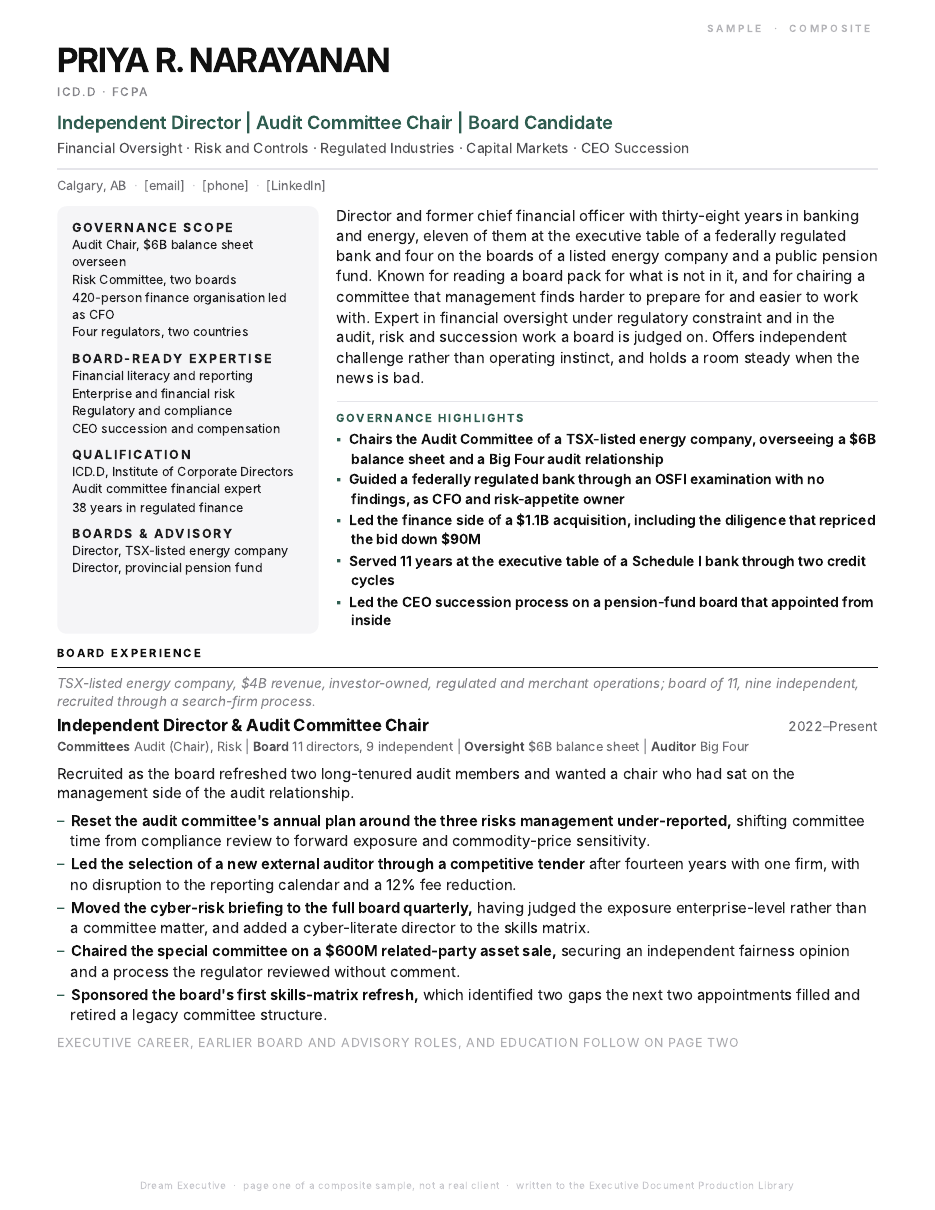
Three documents, built together, from the board's side of the table: the board CV, the one-page board biography, and the board value statement, plus a LinkedIn profile rebuilt to match. NACD calls the board resume one of four assets, with the bio, LinkedIn, and your network, and advises starting a new document for the board. I agree, and the reason is simple: the executive resume argues achievement and execution; the board CV argues oversight, judgment and influence.
The board CV
Two pages, occasionally three for a long governance record. Reverse chronological, plain language, quantified, with the context an outsider needs. What recruiters say they want, in Spencer Stuart's words, is a resume with a board value proposition built in. This is the architecture I use.
| Band | What it holds |
|---|---|
| Header | Name, credentials (ICD.D, NACD.DC, FCPA, CFA), a title line in board terms (Independent Director | Audit Committee Chair | Board Candidate), a keyword line (Financial Oversight, Risk, Regulated Industries, CEO Succession) |
| Board value proposition | Two to four sentences at the top: governance exposure, leadership scope, committee-relevant experience, special situations (IPO, spin-off, restructuring, activist defence, regulator), international. Written to the gap in a skills matrix |
| Sidebar | Governance Scope (committees chaired, balance sheet overseen, regulators, boards served), Board-Ready Expertise (four or five areas), Qualification (credentials, independence status), Boards & Advisory |
| Governance highlights | Four or five, fully bold: the audit tender you led, the succession you ran, the examination you passed, the acquisition you repriced |
| Board experience | Each seat: an italic context line (company, size, ownership, board size, how recruited), committees and role, and a short story of what you changed on the board |
| Executive career | Condensed. Each role carries the board-facing duties: investor and regulator interaction, audit relationship, committees presented to, succession, capital decisions. One-line company descriptors with ownership and revenue |
| Education and credentials | Last. Governance education named |
The vocabulary matters. NACD's guidance is to use governance language (fiduciary duty, oversight, independent challenge) and strip generic phrases, mission-statement copy and task descriptions. Chief Executive's version: prefer led the process, facilitated, coached to executed and implemented. Egon Zehnder's test is whether you understand the line between oversight and management, because a CEO's fear is a director in the weeds.
A governance highlight at the standard. Led the selection of a new external auditor through a competitive tender after fourteen years with one firm, with no disruption to the reporting calendar and a 12% fee reduction.
The board biography
One page, prose, with a headshot, formatted like a speaker biography. The length that every recruiter source supports is roughly 300- to 400-words; the 150-word bio you may have seen recommended is a LinkedIn summary. Third person is fine. It is the document the nominating chair reads first, the one a search partner forwards, and the one a director reads on a phone between meetings.
Structure, from Spencer Stuart and NACD: the value proposition first, then board experience (including your own company's board and your interactions with investors, regulators, rating agencies, and analysts), then the career in titles and scale, then education and credentials, then affiliations and speaking. Egon Zehnder adds the three questions every board bio has to answer without being asked: where you sat in the reporting structure, what P&L you carried, and what exposure you have had to boards. P&L is the most asked-about experience, so state it. Focus on three or four areas of expertise with a headline and evidence for each; leave out early career and minor roles; do not claim industry expertise from a single seat.
Style: strong verbs, no helped or contributed, no self-descriptors (passionate, team player, strategic thinker), no dates on every line, and a generic core that is tailored per board. The bio supplements the CV. It does not replace it.
The board value statement
A short letter or note, under 250 words, for the nominating chair, the search partner, or the director who is introducing you. It names the board, names the gap you fill in the matrix, and says in two sentences what you would bring to the committee that needs you. It is an expression of interest with evidence attached. Spencer Stuart's line is that expressing interest opens doors and asking for a nomination closes them. BoardProspects puts it well: the pitch must be short enough that your advocates can repeat it accurately.
The skills matrix is your brief
80% of S&P 500 boards publish a skills matrix in the proxy, and Canadian non-venture issuers must describe the competencies the nominating committee seeks under Form 58-101F1. Read the target company's matrix, find the thin column, and write the value proposition to that gap. Saying you want to be on a board gives the chair nothing to work with. Saying that their matrix shows no director with regulated-industry risk experience, and that you chaired that relationship through two examinations, gives her a reason to call.
LinkedIn for the board candidate
The profile is where a search firm's researcher finds you. The headline leads with the value proposition; the About section carries the governance vocabulary a researcher searches for while persuading the human who reads it; the Experience section carries the board-facing duties inside each operating role. Keep it current, do not let it read like a CEO resume, and tell your advocates in plain words that you are open to board roles and what you bring. In my process the profile is rebuilt after the CV and bio are final, so all three say the same thing.
Executive resume: achievement and execution. Board CV: oversight, judgment and influence.
Same career. Different reader. Different document.
7. The mistakes first-time candidates make
Compiled from Spencer Stuart, Egon Zehnder, Heidrick, Korn Ferry, and the board-pipeline organizations, and consistent with what I see in the documents that arrive on my desk.
- Asking for a nomination. Expressing interest is what works. Spencer Stuart's first item, and the one that costs the most.
- Saying you want a board seat without naming the board and the gap. Generic interest produces generic introductions.
- Adapting the executive resume. It argues execution; the board wants oversight. Start a new document.
- Writing the bio as an interview on paper. It is a fit statement. No adjectives, no passive verbs, no self-praise.
- Overstating non-profit, private, or venture board experience. Egon Zehnder's caution. Count the committee work; do not inflate the seat.
- Assuming a training course qualifies you. It helps your second seat. It does not produce your first.
- Targeting only public boards. They have the fewest openings. Private, growth, and non-profit boards are where most first seats are.
- Treating the board interview as a job interview. Expect the nominating chair, the board chair and the CEO. Answer why this board with the value you bring to them. Boards are not looking for cheerleaders.
- Vague diversity claims. Egon Zehnder: weak. Specific contribution: strong.
- Not clearing it with your own board or CEO first. Employer restrictions on competitors and geography are real, and an appointment that surprises your chair ends badly.
- Exaggerating. Boards run background checks. A pattern of short tenures raises concern on its own.
- Underestimating the time. BoardProspects: plan for a commitment at least 50% larger than the time stated up front. Retirees' calendars fill faster than expected (Heidrick).
- Going stale between roles. Korn Ferry: directors who have been out of the business sphere for long periods do not serve companies well. Currency of perspective is a selection criterion.
- Being swayed by the brand. Heidrick's test: are you willing to tie your reputation to theirs. Egon Zehnder's: is this a group of people you want to face a crisis with.
8. The timeline, and the plan
No dataset measures the time from deciding to pursue a seat to the first appointment, so every figure you will read is a practitioner estimate. The honest ranges: Spencer Stuart says a single search can take several months and patience is essential; Egon Zehnder says results may take several years and director searches often run longer than executive searches with long gaps between steps; Athena Alliance says two to three years even for well-qualified members; practitioners with clear targets and a strong value proposition claim twelve months. The structural facts set the floor: S&P 500 boards average 2.3 years between appointments, only half add anyone in a given year, and committees interview two or three people per opening.
My synthesis from the work: 12 to 24 months for a well-positioned executive pursuing private, non-profit or mid-cap seats; two to three years or more for a first large-cap public seat; and three to nine months for an individual search once you are in it. Start while you are still at the top of your operating game, because that is when the network is warmest and the perspective is most current.
The plan
- Month 1. Decide the board type and two or three target committees. Audit your own qualification against the SEC expert attributes or NI 52-110. Build the board CV, biography, and value statement. Rebuild LinkedIn to match.
- Months 1 to 3. Tell twenty people, in writing, that you are open to board roles, which types, and what you bring, in a sentence they can repeat. Sitting directors, your CEO and chair, search partners who placed you or whom you hired through, your auditor, and your lawyer. Ask for introductions to board practices.
- Months 3 to 12. Read the proxies and circulars of ten target companies. Find the thin column in each skills matrix. Send the value statement to the right person at each. Take one non-profit or private committee role if you have no governance record, and chair something on it. Touch the network every three to four months with a reportable reason.
- Months 12 to 24. Apply to posted Crown and agency opportunities with a mapped cover letter. Consider the ICD.D or NACD.DC once you hold a seat. Keep the perspective current: speak, publish, sit on a panel.
- When the call comes. Expect two to three interviews over several months. Prepare references who are experienced public directors. Confirm your own board supports it. Ask yourself the crisis question before you say yes.
You cannot apply for a board seat. You can be the obvious answer when the chair asks around.
The document set is how you become that answer in writing. If you want it built, the discovery call is thirty minutes.
Sources
- Spencer Stuart, 2026 US Board Index and 2025 US Board Index (new director and compensation snapshots); 2025 Canada Board Index; Becoming an Independent Director; Your Board Bio: Storytelling to Connect the Dots; The PE-Backed Portfolio Company Board; Director Pulse Survey on time commitment.
- Heidrick & Struggles, Board Monitor US 2026 and 2025; Board Monitor Canada 2025; So You Want to Join a Board.
- NACD, 2025 Inside the Public Company Boardroom; Board Resume Writing Tips; Directorship Certification requirements. Institute of Corporate Directors, Directors Education Program 2026 to 2027.
- Russell Reynolds, Global Corporate Governance Trends 2026; Global Board Culture and Director Behaviors Study 2025. Korn Ferry, The Directors You Need But Cannot Find; 2026 CEO & Board Survey.
- Egon Zehnder, Positioning Yourself for First-Time Board Service (Parts I and II); board biography guidance. Diligent Institute and Corporate Board Member, What Directors Think 2026. PwC, 2025 Annual Corporate Directors Survey.
- FW Cook, 2025 Director Compensation Report. Southlea Group, 2025 TSX Director Compensation Trends. Private Company Director and Compensation Advisory Partners, 2025 Private Company Board Compensation Survey. Bolster, on independent director equity. Privy Council Office, Governor in Council appointments and Crown corporation remuneration guidelines. Coast Capital Savings, director remuneration.
- SEC, audit committee financial expert rule (Release 33-8177, via Wiggin and Dana summary). Ontario Securities Commission, NI 52-110 Audit Committees. Osler, 2025 Diversity Disclosure Practices (CBCA). Goodmans, on CSA Multilateral Staff Notice 58-317. Alston & Bird, on the Fifth Circuit's vacating of the Nasdaq diversity rule (December 2024). The Conference Board, Corporate Diversity Disclosure 2025.
- Deloitte, Unlock Value with PE Portfolio Company Governance (2026). Gibson Dunn, Board Education Opportunities (October 2026). BoardProspects, Navigate Forward, Athena Alliance, Chief Executive, Board Appointments, Chilmark Advisors (practitioner estimates, cited as such). Stanford Social Innovation Review and BoardSource on non-profit recruitment.