This guide is written for the executive who is about to go to market, or who has been on the market for three months and is not getting the calls. It is also for the one who has not needed a resume in twelve years and is about to find out how much has changed.
I have written executive documents since 2013, across 3,000+ engagements for senior leaders in every function and most industries. What follows is the standard I write to, with the 2026 market data behind it. Where a number comes from a report, the report is named. Where it is my judgment from the work, I say so. The two are not the same and I will not pretend they are.
Read the sections you need. Section 1 is the market. Section 2 is how the document is read today, and it surprises most executives. Section 3 is the standard. Sections 4 and 5 are the long ones: function by function, then company type by company type. Section 6 is AI. Section 7 is the checklist. If you only have ten minutes, read 2, 3, and 7.
1. The 2026 executive market, in numbers
Two things are true at once in 2026. Chief executive departures came off a record year, and demand for proven senior leaders went up. If you only read the headlines about exits falling you would draw the wrong conclusion.
Turnover is high and the bar for who replaces whom has moved
- 234 CEO departures across 13 global indices in 2025, the most in eight years. 86% of the people appointed were first-time listed-company CEOs. Outgoing tenure was 7.1 years, down from 8.3 in 2021. (Russell Reynolds Global CEO Turnover Index)
- 168 new CEOs in the S&P 1500 in 2025, the most since 2010. 60% were internal. The feeder seat has changed: 48% came from COO or president, 30% from a divisional CEO role, and only 9% from CFO, down from 16% a year earlier. (Spencer Stuart, Behind the CEO Moment)
- Boards are reaching for experienced CEOs when they are nervous. In the S&P 500, 41% of Q1 2026 appointments had already been a public-company CEO, against 9% two years earlier. Russell Reynolds reads it as boards wanting proven leaders where performance must be stabilized or investor confidence rebuilt.
- US CEO exits are down 24% through May 2026 against 2025's record (Challenger, Gray & Christmas). Interim appointments fell from 22% of incoming CEOs to 13%. Fewer caretakers, more permanent decisions.
The functional seats are moving faster than the corner office
- CFO appointments hit a seven-year high: 316 globally in 2025, a record 106 in the S&P 500. The experienced-CFO share rose to 43%. Russell Reynolds describes the brief as ready-now, able to build confidence with investors and the board, with operational and enterprise-wide influence beyond finance.
- The COO is back. 146 appointments in 2025 against 65 departures, a net 81 new seats. 82% internal. The COO is now the single most common route to CEO.
- CHRO appointments ran above the eight-year average in the first half of 2026, and the S&P 500 swung hard to experienced CHROs, with first-timers down to 39%, the lowest since 2019. (Russell Reynolds, via HRD Canada)
- CMO tenure in the S&P 500 is 4.1 years against a C-suite average of 5.0, and 31% of S&P 500 companies have no CMO at all. (Spencer Stuart)
Retained search demand is up
Korn Ferry's executive search segment grew 9% in the fiscal year ended April 2026, with North America its fastest-growing region in the final quarter. That is the cleanest public proxy for C-suite demand there is, and it points the other way from the exit headlines. Two-thirds of search firms report using AI tools in their workflow, which changes how you are found (Section 2). What a partner reads for stays the same.
How long it takes
Vendor benchmarks, so treat them as ranges: director searches run 6 to 12 weeks, VP 8 to 14, C-suite 12 to 16 or more. The front end has compressed as firms use AI to build long lists. The decision stage has not. Budget four months from first conversation to signed offer for a C-suite retained search, and assume the first six weeks of that happen before you know you are on the list.
Canada
Canadian data sits inside the global indices with no published Canadian cut, so I will not quote a Canadian CEO turnover rate. What is published is the board side: in 2025, 55% of new independent directors on Canada's 100 largest public boards had CEO or C-level experience, and the CEO share jumped from 24% to 35% in one year (Spencer Stuart Canada Board Index). For a Canadian executive that is a direct instruction about what to put at the top of page one. Canadian executive merit increases were the lowest of any employee group at 2.5% (Mercer Canada), while median TSX CEO total pay rose nearly 12% to C$6M (ISS-Corporate). The money is in the long-term incentive, which means the comp committee is paying for relative TSR and profitability, which means those are the outcomes your resume should quantify.
The market is paying for proven, enterprise-wide, ready-now leaders.
Every section of your resume has to answer the same question a board is asking: has this person already done, at scale, the thing we need done next.
2. How your resume is actually read
Most executives write a resume as if it were an application. At your level it is a dossier input, and that changes everything about how it should be built.
Retained search starts with a map
A retained firm builds the long list by market-mapping: researchers identify who holds the equivalent job today, who was recently promoted, who seems blocked, who spoke at the right conference, who sits on which board. The long list is 50 to 100 names. The short list is three to five, each with a detailed dossier. Direct, confidential outreach to people who were not looking is the main route to a hire.
Your resume enters that process after you are already on a list. It is read first by a researcher or associate assembling your dossier, then by the partner preparing the client presentation, then by the client. It is a verification and packaging document. The discovery document is your LinkedIn profile, which is why the two must say the same thing and why the profile gets rebuilt once the resume is final.
The six-second myth, dated properly
The only eye-tracking study anyone cites is from 2018 (Ladders, 7.4 seconds on the initial screen, up from six seconds in 2012). It measured a volume recruiter's triage pass, with a sample size never disclosed. It did not measure a search partner reading a shortlisted executive's dossier. The lesson that survives is about layout: simple structure, clear section headings, bold titles, bulleted accomplishments, and white space held attention; cluttered multi-column layouts and long sentences lost it.
ATS at the executive level: a searchable database
You will be told that 75% of resumes are rejected by software before a human sees them. There is no primary source for that number. The best study available, a small 2025 panel of recruiters across ten platforms, found 92% of their systems do not auto-reject on formatting, keywords, or AI match scores. Where automated rejection exists it is for legal and compliance criteria: work authorization, licences, location.
At C-suite the applicant tracking system is a database of record. At a search firm it is Invenias, Clockwork, Thrive, or Bullhorn; at a corporate it is Workday or Greenhouse. A human searches it by keyword and Boolean. That means two things matter: your titles, dates and employers must parse cleanly as text (no headers in graphics, no tables that scramble), and the words a researcher would search for must be present in the words you use. At this level, parsing is what matters.
AI screening reads meaning, and so does the partner
58% of US hiring managers now use AI to screen resumes (Resume Genius, June 2026). Search-firm screening tools use language models that read for context. In the same breath, 88% of hiring managers say they can tell when application materials were written by AI, and of those who care, a quarter read it as lack of effort (Insight Global). Generic copy now fails both readers for the same reason: it has no specific content. Section 6 covers what to do about that.
What a partner is actually reading for
Retained firms are explicit that resumes are insufficient on their own, that they weight behavioural evidence over pedigree, and that they warn clients against pattern-matching on titles at competitors. In practice the partner is reading for four things, in this order:
- Scope. What you actually owned: revenue, P&L, headcount, geography, budget, balance sheet. Stated outright.
- Results with the lever. What moved, by how much, and what you did to move it. A result without a lever is a claim. A lever without a result is a job description.
- Company-type signal. Public, private, sponsor-owned, founder-led. Each reads differently (Section 5), and a partner who cannot tell which you have done cannot place you.
- Trajectory. Whether the career makes the next role the obvious step. This is the summary's job and it is the hardest part to write.
Your resume is read after you are already on a list, by someone building a case for you.
Write it as the evidence file for that case.
3. The standard: what a 2026 executive resume is
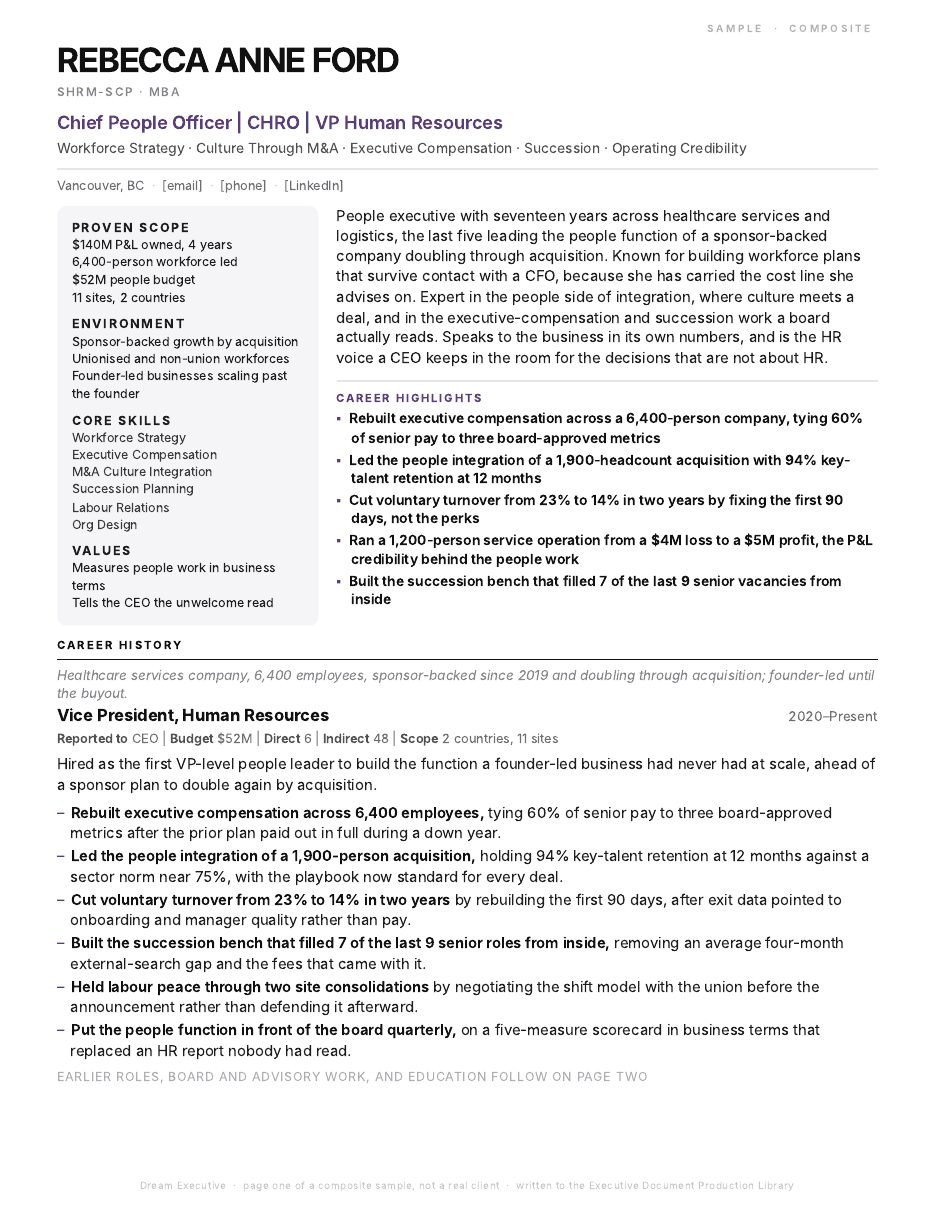
What follows is the architecture I build to. It has held up across 3,000+ engagements, and the samples on the site are built to it.
Page one is a single argument
A search partner, a board member and a CEO should each be able to read page one alone and know what you are for. The page is built in four bands.
| Band | What it holds | What it is doing |
|---|---|---|
| Header | Name, credentials, one title line (the roles you are targeting, pipe-separated), one keyword line (five or six capabilities), contact | Tells the reader what seat you are a candidate for before they read a word of prose |
| Left sidebar | Proven Scope (four numbers), Environment (the company types and situations you have operated in), Core Skills (six to eight), Values (two lines), Boards & Advisory | The scannable column. A researcher can fill most of a dossier from this alone |
| Right column | Summary (four or five sentences, no figures), Career Highlights (four or five, each fully bold, each with a number) | The summary is the trajectory argument. The highlights are the proof |
| Career history | Each role: an italic context line about the company, title and dates, a scope line (Reported to, P&L, Direct, Indirect, Scope), a mandate or story paragraph, then bullets | Where the reader checks the claims against the record |
The rules inside the bands
- The summary carries no figures. Numbers belong in the highlights and the roles. The summary's job is to say who you are and why the next seat is the natural one. Four or five sentences. If it reads as a list of competencies, it has failed.
- Highlights are fully bold and fully quantified. Four or five. Each one is a result and the lever that produced it. These are the lines a partner lifts into the client presentation.
- Every role gets a context line. One italic sentence: what the company is, its size, its ownership, and the situation you walked into. Without it the reader cannot calibrate anything that follows.
- The scope line is not optional. Reported to, P&L or budget, direct reports, indirect, geographic or functional scope. If you did not own a P&L, say what you did own. Omitting the scope line reads as hiding something.
- The mandate paragraph tells the story. Three or four sentences: why you were brought in, what you found, what you decided, how it unfolded. This is where the 2026 resume has moved furthest from the 2016 one. A list of bullets with no story reads as a job description.
- Bullets open with a bold lead of twelve words or fewer, then the lever and the context. Each runs twenty to thirty-five words, with four to six per recent role and two or three for older ones. Result first, then how.
- Verbs do work. Use led, built, took, cut, repriced, integrated, and refinanced. Cut helped, supported, assisted, participated in, and was responsible for.
Length, photos, letters
- Two pages suit almost every executive. Three suit a 25-year, multi-company C-suite career or a board-track document that carries governance and operating history. Four is always too many. There is no 2026 survey of retained consultants on length, so this is my position from the work, and it matches the only recruiter panel data there is (64% prefer two pages or fewer).
- No photo in the US or Canada. Many Canadian employers strip photos before circulating a resume. Germany, France, the Gulf, and Japan expect one. If you are targeting those markets you need a second version.
- No cover letter in the old sense. At retained level the letter is the email to the partner or the note to the board chair, and the longer document is the executive biography. What I build instead is a value statement letter: one letter that four readers can use (a search firm, a hiring CEO, a board, your own network), 150 to 250 words, that says what you are for and why now.
Design
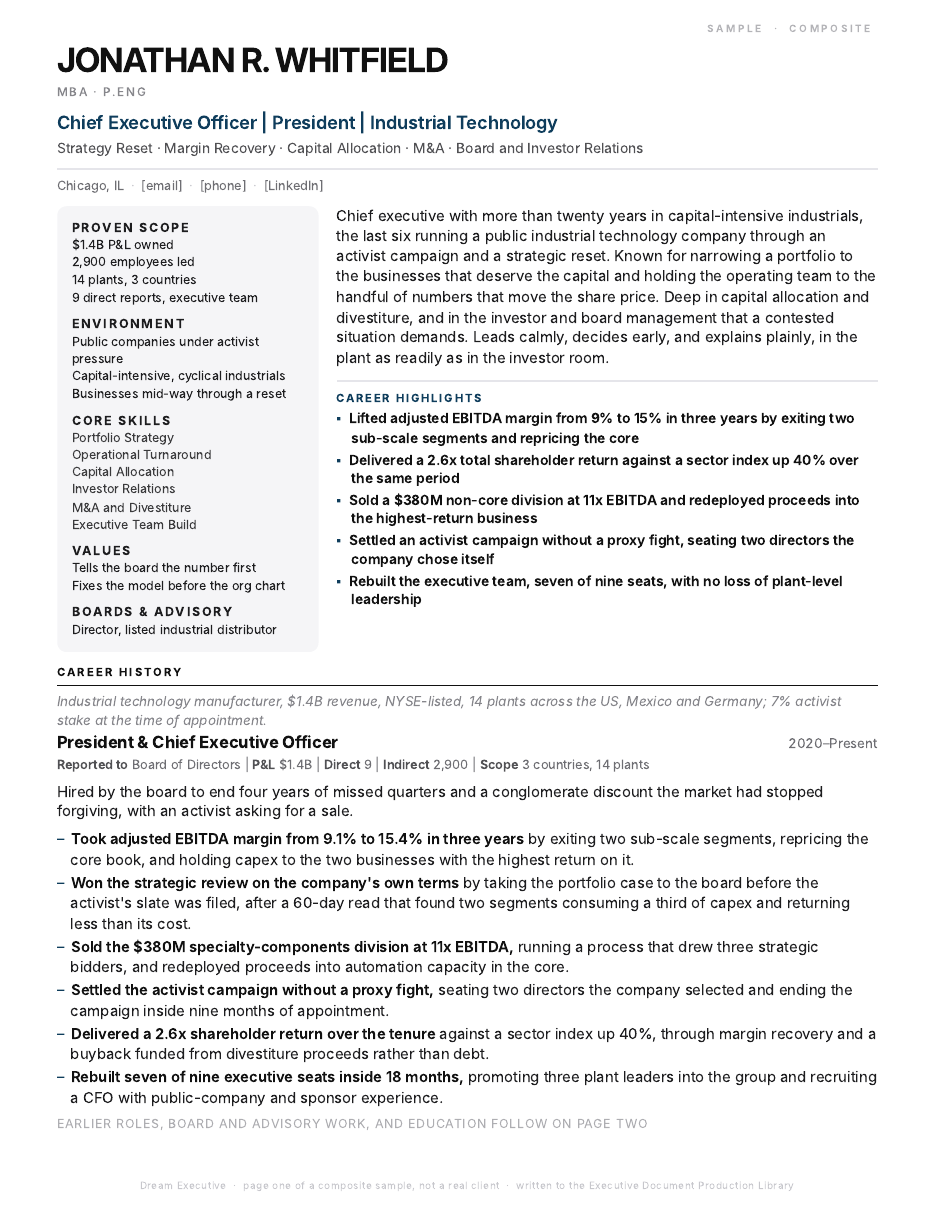
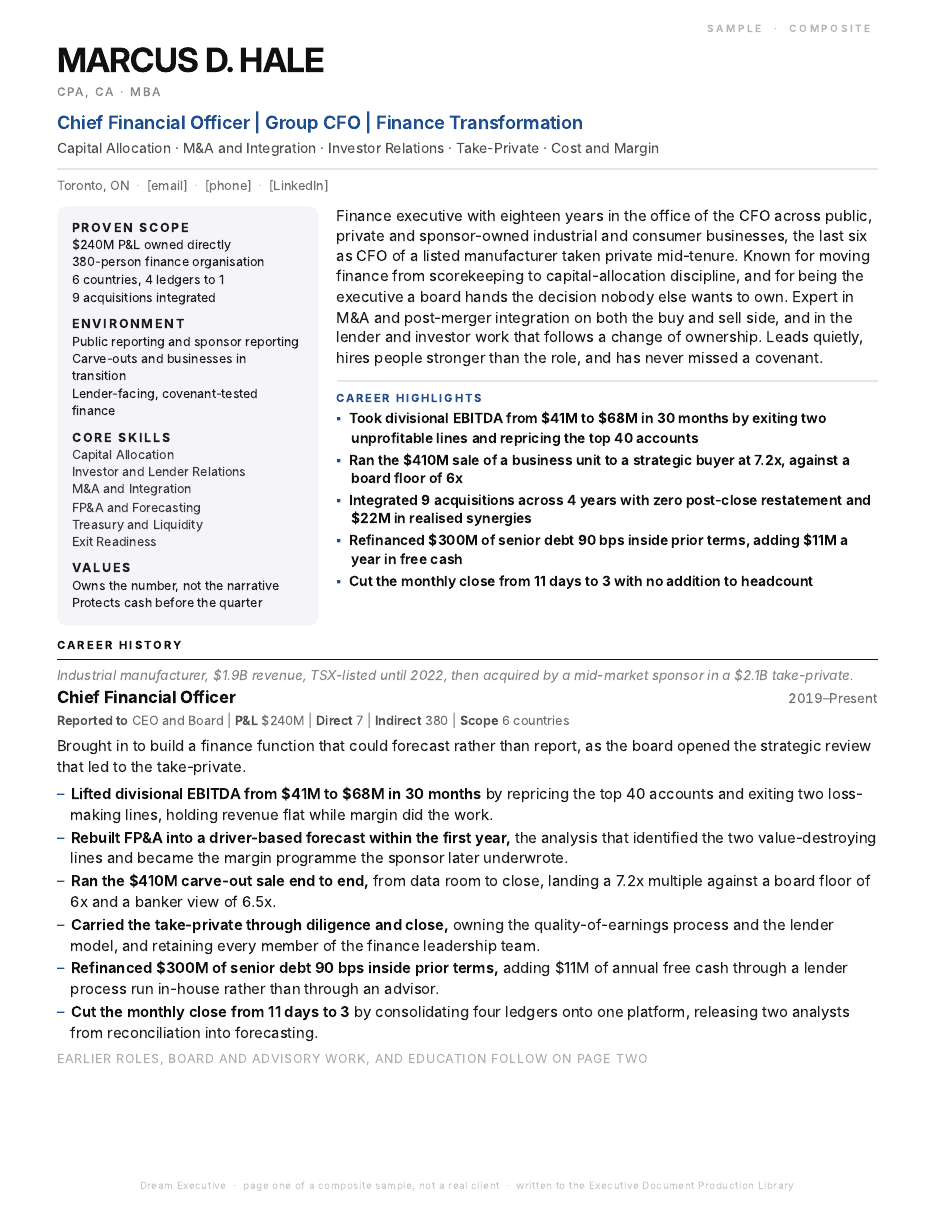
Clean, one accent colour, a real typeface, generous white space, dates right-aligned, consistent punctuation. A two-column top band and a single-column history parses correctly in every system I have tested because the columns are built as a layout with no table. Decorative graphics, skill bars, icons, and photographs of handshakes read as a template, and a partner has seen that template two hundred times. The samples on the site show the standard.
4. Function by function: what each seat is being hired for in 2026
The same resume architecture holds across the C-suite. What changes is what goes in the scope line, which four numbers lead the sidebar, which highlights make the top five, and what the summary argues. For each seat below: what the market is hiring for now, the metrics boards and recruiters weight, and what that means for your document. Where the metric list is my own synthesis from the work, it says so.
Chief Executive Officer
What the seat is being hired for. Transformation and AI execution with less patience for weak growth (Spencer Stuart). Boards favour the proven CEO when the situation is a reset: 41% of S&P 500 appointments in Q1 2026 had done the job before. CEOs themselves say adaptability (92%) and geopolitical navigation (87%) define the role (Egon Zehnder). AI return on investment has become a formal evaluation input: CEOs estimate 35% of their assessment rides on it, boards say 27% (BCG, May 2026).
What gets weighted.
- Relative total shareholder return, the most common and most heavily weighted long-term incentive metric in both the US and Canada (WTW).
- Profitability, which carries 25 to 50% of annual scorecards.
- Revenue growth and transformation milestones.
- Succession bench depth, since half of boards say they started succession too late (Korn Ferry).
- Capital allocation and M&A outcomes, my synthesis.
What your resume has to show.
- Enterprise P&L, stated.
- Share price or valuation outcome over your tenure against a benchmark.
- One capital-allocation decision, described as a choice you made.
- Board and investor relations as a named competence with evidence.
- The executive team you built and what happened to it.
- If you came up through COO or divisional president, which 78% of new CEOs did, the resume has to make that path read as preparation.
A bullet at the standard. Lifted adjusted EBITDA margin from 9.1% to 15.4% in three years by exiting two sub-scale segments, repricing the core book, and holding capex to the two businesses with the highest return on it.
Chief Financial Officer
What the seat is being hired for. Ready-now. Able to build confidence with investors and the board, lead through transformation, and carry influence beyond finance (Russell Reynolds, on a record year for CFO hiring). Deloitte's CFO Signals puts digital transformation of the finance function as the number one 2026 priority, with 54% naming AI agents in finance a top transformation item and 63% saying AI is deployed but only 21% seeing tangible value. The first-quarter 2026 headline was cost control.
What gets weighted.
- Investor and board confidence, qualitative but decisive.
- Cost and margin outcomes.
- Finance-function transformation delivered, with the value attached.
- Capital structure and liquidity results.
- Forecast accuracy and close speed, my synthesis, and the two numbers a CEO will quote about you unprompted.
What your resume has to show.
- The number you owned and whether you hit it.
- Capital-markets or lender work with amounts and terms.
- One transformation of the function described with before-and-after figures.
- If you have been through a take-private, a listing, a carve-out, or a refinancing, each is a highlight.
- Note the CFO-to-CEO path narrowed to 9% of new CEOs in 2025; if CEO is your target, the resume needs operating and commercial evidence.
A bullet at the standard. Cut the monthly close from 11 days to 3 by consolidating four ledgers onto one platform, releasing two analysts from reconciliation into forecasting.
Chief Operating Officer, Divisional President, General Manager
What the seat is being hired for. End-to-end operational leadership that turns transformation strategy into measurable results (Russell Reynolds, on a seven-year high in COO appointments). The drivers are AI adoption, digital acceleration, supply-chain complexity, and enterprise transformation. The seat has become the primary route to CEO, so the implicit test is whether you are CEO-ready. A divisional president or GM is judged like a mid-cap CEO: on the division's P&L, share, and bench.
What gets weighted.
- P&L, EBITDA, and margin for the span of control.
- Operating-model or AI transformation delivered.
- Service levels, cost-to-serve, supply-chain outcomes.
- Integration results where M&A was involved.
- Succession readiness.
What your resume has to show.
- Full P&L ownership stated on the scope line, with headcount and sites.
- One operating-model change described as a story with a result.
- Integration or turnaround evidence.
- The summary should argue enterprise breadth, because that is what the board reading a COO resume is deciding about.
A bullet at the standard. Turned a $4M regional loss into a $5M profit in three years by renegotiating two depot leases and resetting the shift model together with the union.
Chief Revenue Officer, Chief Commercial Officer
What the seat is being hired for. Growth without the pricing lever. CRO tenure is the shortest in the C-suite, around two years, and boards too often expect a 90-day turnaround (The Official Board). Companies that replaced CROs frequently saw revenue stagnate afterwards, which means the next hire is being made carefully and the reader is wary of sales heroics.
What gets weighted.
- Net new revenue or bookings against plan.
- Net revenue retention.
- Sales efficiency and payback.
- Pipeline coverage and forecast accuracy.
- Margin on the revenue, which is the pricing-discipline test.
- All synthesis anchored to the sources above; VC and PE readers add repeatability.
What your resume has to show.
- Numbers against plan, by year, and the retention figure beside the growth figure.
- The system you built (segmentation, coverage model, comp plan, enablement) as the lever, so the result reads as repeatable.
- Forecast accuracy is the quiet credibility number; include it.
A bullet at the standard. Grew net new ARR from $31M to $58M in two years while lifting net revenue retention from 103% to 118%, by rebuilding the coverage model around the top 60 accounts and moving comp to multi-year value.
Chief Marketing Officer
What the seat is being hired for. Revenue attribution, customer lifecycle, and AI-driven personalization. Tenure is 4.1 years in the S&P 500 and the seat is being quietly redefined or merged out of existence at a meaningful share of large companies. 38% of hires are external and 43% of those cross industry (Spencer Stuart), so breadth of headline and keyword line matters more here than for most seats.
What gets weighted.
- Marketing-sourced and influenced pipeline and revenue.
- Acquisition cost against lifetime value.
- Brand health where it ties to pricing power.
- Digital and AI personalization outcomes.
- Growth in named segments.
- Synthesis.
What your resume has to show.
- P&L-adjacent framing throughout.
- 9% of departing S&P 500 CMOs became CEOs elsewhere and 62% advanced; the ones who did had documents that read as commercial leadership with marketing as the lever.
- Budget on the scope line.
- One brand or demand outcome with a number and the business result it drove.
A bullet at the standard. Rebuilt demand generation around three named segments, taking marketing-sourced pipeline from 22% to 41% of bookings and cutting acquisition cost per customer 28% in 18 months.
Chief Human Resources Officer, Chief People Officer
What the seat is being hired for. Enterprise transformation: organizational design, operating-model change, culture, and the workforce implications of AI (Russell Reynolds). CEOs want an enterprise business leader, and the S&P 500 is hiring experienced CHROs, 65% external. 91% of CHROs name AI and digitization their most immediate concern, and only four in ten are confident their organization is ready (CHRO Association, LHH).
What gets weighted.
- Succession bench depth, which boards list as a 2026 expectation of management (WTW).
- Workforce productivity and AI-enabled redesign.
- Regretted attrition and engagement.
- Total-rewards cost.
- Pay-transparency compliance in Canada.
What your resume has to show.
- People outcomes stated in business terms: retention as a cost avoided, succession as search fees and gaps removed, redesign as margin.
- Executive compensation and board-committee work as evidence of enterprise seniority.
- An operating role anywhere in the career is a highlight, because it is the credibility a CFO reads for.
A bullet at the standard. Built the succession bench that filled 7 of the last 9 senior roles from inside, removing an average four-month external-search gap and the fees that came with it.
Chief Information Officer, Chief Technology Officer, Chief Data, or AI Officer
What the seat is being hired for. Agentic AI return on investment beyond the pilot stage (Gartner's 2026 CIO agenda). AI spend is up more than 35% year on year inside tight budgets, 64% of CIOs plan to deploy agentic AI within 24 months, and digital sovereignty has become a board matter. The Chief AI Officer now exists at nearly a quarter of the Fortune 500, with an average tenure of 2.2 years and 47% hired from outside (Avasant). The top barrier the rest of the C-suite names is lack of executive understanding of new technology (LHH), which means your resume has to translate.
What gets weighted.
- AI and transformation value against stated targets.
- Run-cost reduction against change spend.
- Cyber and sovereignty posture.
- Data quality and governance maturity.
- Engineering velocity for CTOs.
- Synthesis anchored to Gartner and Deloitte.
What your resume has to show.
- Business outcomes first, technology second, in every bullet.
- Budget and team on the scope line.
- One AI or platform program with a measurable value delivered, since the market is now distinguishing between deployment and value.
- If you are a CTO in a product company, shipping cadence and revenue tied to the product.
A bullet at the standard. Consolidated 14 regional ERP instances to one global platform in 22 months, under a $48M budget, cutting run cost $11M a year and giving the CFO a single close for the first time.
Chief Information Security Officer
What the seat is being hired for. Board-reportable risk at executive level. 47% of CISOs now hold EVP or SVP titles, up from 33% in 2023, and 36% report outside IT to the CEO, COO, or general counsel (IANS). Executive-level CISOs are twice as likely as VP-level to report to a business leader. 69% are open to moving in the next year, so the market is liquid.
What gets weighted.
- Quantified risk posture and regulatory readiness (SEC cyber disclosure, OSFI B-13 in Canada, NIS2 in Europe).
- Incident outcomes and time-to-detect and recover.
- Third-party and AI risk governance.
- Program cost against coverage.
- Audit results.
- Synthesis anchored to IANS reporting-line data.
What your resume has to show.
- Reporting line and board exposure on the scope line.
- Risk expressed in business terms (exposure reduced, audit findings closed, regulatory examinations passed).
- Program build from scratch is a highlight in mid-cap and PE contexts; board-facing risk governance is the highlight in regulated public companies.
A bullet at the standard. Took the company through its first SEC cyber-disclosure cycle and an OSFI B-13 review with no findings, having rebuilt third-party risk coverage from 40% of critical vendors to 100% in 14 months.
General Counsel, Chief Legal Officer
What the seat is being hired for. Strategic leadership through trade, tariff, and AI regulation. 84% of CLOs now report directly to the CEO, 47% say the CEO expects them to build AI proficiency, and 20% rank growth barriers a greater concern than litigation (ACC 2026 CLO Survey). Nearly half rely more on outside counsel under budget constraint.
What gets weighted.
- Regulatory and deal enablement.
- Legal spend and the outside-counsel ratio.
- Litigation and dispute outcomes.
- Board governance and disclosure quality.
- Privacy and AI program maturity.
What your resume has to show.
- Transactions with values.
- Regulatory navigation described as a business outcome (a deal closed, a market entered, a tariff exposure managed).
- Board and committee exposure stated.
- Spend managed as a number.
A bullet at the standard. Closed a $1.1B cross-border acquisition through a 14-month CFIUS and Competition Bureau process, and brought legal spend down 19% by moving two practice areas in-house.
Chief Strategy Officer
What the seat is being hired for. Cross-functional transformation ownership. Nearly two-thirds of CSOs lead transformation, more than half drive enterprise agendas beyond the traditional remit, and 28% co-lead AI decision-making (Deloitte 2026 CSO Survey). Half have five or fewer direct reports, so influence is the evidence.
What gets weighted.
- Transformation programs delivered with measurable value.
- Portfolio moves: M&A, divestiture, new lines.
- AI strategy ownership.
- Planning quality.
- Synthesis.
What your resume has to show.
- Decisions you shaped with the outcome attached, since the span of control is small.
- Deals with values.
- A line on how the planning cycle changed under you.
- If the target is an operating seat, lead with any P&L you have carried.
A bullet at the standard. Led the strategic review that narrowed the portfolio from seven businesses to four, including the $380M divestiture, and redeployed proceeds into the two with the highest return on capital.
The seat decides which four numbers lead the sidebar and which five highlights make the cut.
The architecture does not change. The evidence does.
5. Company type by company type: the same career, reframed
A partner cannot place you if they cannot tell which kinds of company you have run. The reader at a sponsor, a family office, a public board, and a non-profit are reading for different things, and the most common failure I see in executive resumes is a career that could have happened anywhere. What follows is how the framing shifts, what to lead with, and what to cut.
Public, large-cap
73% of S&P 500 CEO appointments were internal in 2025, and departing large-cap CEOs in early 2026 had served nearly 12 years. The reader is a board, often through a search firm, and the question is whether you have already operated at enterprise scale with investors and regulators watching. Experienced CEOs are suddenly in favour where a reset is needed.
Lead with.
- Enterprise P&L and balance-sheet scope.
- Investor, analyst, and regulator exposure as named experience.
- Relative TSR or valuation outcomes over your tenure.
- Board management.
- Succession you built.
- The context line should name the exchange.
Cut or demote.
- Early-career detail.
- Anything that reads as small-company scrappiness without a scale number attached.
- Long lists of initiatives.
Public, mid-cap and small-cap
59% internal at mid-cap, 50% at small-cap, and 89% of mid-cap appointments were first-time CEOs. This is where the external, first-time, growth-plus-transformation candidate has the best odds, and where the board is buying a specific operating plan.
Lead with.
- Growth and margin outcomes with the lever.
- Operational turnaround evidence.
- Capital discipline on a constrained balance sheet.
- One story of doing more with a smaller team.
Cut or demote.
- Large-company process language.
- Anything that implies you need a big staff to execute.
Private-equity-backed
65% of sponsors report replacing the CEO during the hold, and sponsors say growth, AI adoption, and acquisitions matter more to them than to management (AlixPartners 2026). 97% want an always-exit-ready CFO; 20% have one (Accordion). The reader is a deal partner or portfolio talent lead, and they read for one thing: can this person move EBITDA inside the hold period.
Lead with.
- EBITDA, cash conversion, exit outcomes, and multiples.
- Hold position (when you arrived and left relative to entry and exit).
- Owned versus advised, kept rigorously separate.
- 100-day plans, bolt-on integration, carve-outs.
- The context line names the sponsor type, entry and exit multiples.
Cut or demote.
- Corporate narrative, culture language, anything without a number.
- Titles in place of outcomes.
- The separate PE guide covers this in full.
Founder-led and private
Deloitte Private expects a meaningful shift toward outside professionals in the chief executive role as founders succeed themselves, with family members still largely at the helm. The reader is a founder, a family council or a trusted adviser, and the question is whether you can operate inside governance that is still being built, without making the founder feel replaced.
Lead with.
- Evidence of professionalizing a function or a company: first audit, first board, first real planning cycle.
- Stewardship outcomes.
- Succession partnership.
- Judgment under ambiguity, shown through a story.
Cut or demote.
- Public-company process and committee language.
- Anything that implies you need a structure that does not yet exist.
Family-owned
A subset of the above with longer horizons and a different definition of risk. The next generation increasingly declines the seat, which creates the opening, and the family wants continuity of values with a professional result.
Lead with.
- Multi-year outcomes.
- Relationships held across generations or ownership changes.
- Cost discipline and cash.
- One example of saying no to the family and being right.
Cut or demote.
- Short-tenure moves without explanation.
- Exit-driven language.
Venture-backed growth
Seed-stage companies are now expected to show revenue early, leaders must prove adaptability and technology integration, and teams are lean with no middle management (Riviera Partners). COO and CTO are hired to build the machine; the CFO arrives around Series B or C to build the model and the board pack.
Lead with.
- ARR trajectory, capital efficiency, fundraising rounds with amounts, and board and investor management.
- Speed: what you built and how fast.
- Evidence you have operated with fewer people than the job needed.
Cut or demote.
- Large-company scale numbers that do not translate.
- Process and governance language without a growth result attached.
- The PE guide's VC section covers the letter.
Non-profit, public sector, and Crown corporations
Government and non-profit is the single largest source of CEO exits in Challenger's 2026 count, and 55% of non-profits say they cannot offer competitive salaries. The reader is a board of volunteers or appointees, a selection committee, or a ministry, and the test is mission fit, stewardship, and the ability to deliver with constrained resources.
Lead with.
- Mission alignment stated outright in the summary.
- Resource development and fundraising with amounts.
- Governance and board work.
- Financial stewardship: reserves, audits, grant compliance.
- Stakeholder and public management.
Cut or demote.
- Commercial aggression.
- Exit and multiple language.
- Anything that reads as motivated by comp.
One career, one architecture, and a different set of leading numbers for each reader.
If you are targeting two company types, you need two versions of page one. Not two resumes, two first pages.
6. AI and your resume
Let me be plain about where I stand, since the question comes up on every discovery call. I use AI in the work the way an architect uses CAD: for research, for stress-testing phrasing, for checking blind spots. The judgment about what matters in your career is mine, and the voice is yours. What follows is what the data says and what I see.
What the surveys say
- 58% of US hiring managers have received AI-generated application materials and 58% use AI to screen them (Resume Genius, June 2026).
- 88% of hiring managers say they can tell when materials were written by AI. Only 54% care. Of those who care, 36% see it as a positive signal of AI fluency, 24% as lack of effort, 17% as impersonal (Insight Global, fielded late 2024).
- 74% of US job seekers use AI somewhere in the search (Greenhouse). Resume and cover-letter writing is the top use case and growing fast (iHire).
- There is no executive-specific survey of ChatGPT-written resumes. The general data is what exists, and it is vendor-run. Treat the direction as reliable and the percentages as approximate.
How generic AI copy gets spotted
The tells are consistent across every practitioner list, and they are tells of generic writing, whoever or whatever wrote it: buzzword openers (results-driven, dynamic, proven track record), achievements with no scope or context, keywords mirrored verbatim from the posting, every bullet with the same rhythm and length, polished prose with no concrete content, and a resume the candidate cannot defend line by line in the interview. A language-model screener reads context, and so does a partner. Both reject the same document.
What executives get wrong
- Treating the resume as an inbound application. It is a dossier input (Section 2). AI tools are trained on the application model and will push you back toward it.
- Letting the tool flatten scope. The numbers a board uses (TSR, EBITDA, net retention, AI return, succession depth) are absent from generic output because the tool does not know them. Only you do.
- Keyword mirroring. A screener reads it as low effort and a partner reads it as a candidate who does not know what they are for.
- Uniform bullet rhythm and no company-type signal. The output cannot tell a sponsor from a family office. The reader can.
How to use it well
Use AI to draft questions for yourself, to find the industry's language for something you did, to check a bullet for weak verbs, and to adapt a finished document to a specific posting without changing its substance. Do not use it to decide what to lead with, to invent scope you cannot defend, or to write the summary. The summary is the one paragraph that has to sound like a person a board would hire, and no model has met you.
7. Before you send it: the checklist
Twenty checks. If any fails, the document is not ready.
- The title line names the seats you are targeting.
- The sidebar's four scope numbers are the four a researcher would put in the dossier.
- Environment names the company types you have operated in, in words a sponsor, a board, and a founder would each recognize.
- The summary has no figures and argues trajectory.
- Four or five highlights, fully bold, each with a number and a lever.
- Every role has a context line that states size, ownership and situation.
- Every role has a scope line. Reported to, P&L or budget, direct, indirect, scope.
- Each recent role has a mandate paragraph that tells the story in three or four sentences.
- Bullets open with a bold lead of twelve words or fewer and run 20 to 35 words.
- Every bullet has a result and the lever that produced it.
- No weak verbs: helped, supported, assisted, participated, responsible for.
- No buzzword openers and no phrase that could appear on anyone's resume.
- Dates and titles parse as text. Nothing important lives in a graphic or a table.
- Two pages, three only if earned. No photo for US or Canada.
- Owned and advised are never blurred. Interim, acting and consulting roles are labelled.
- Company-type signal is unmistakable within the first ten seconds.
- The LinkedIn profile says the same thing in the same order, and was rebuilt after the resume.
- The value statement letter exists and is 150 to 250 words.
- You can defend every number and every claim in an interview without notes.
- Someone who does not know you read page one and could say, in a sentence, what you are for.
Board and private equity
If your target is a board seat or a sponsor-backed company, this guide is the foundation and not the whole answer. A board set is built around governance; a PE resume is reordered around EBITDA and the hold period. Both have their own guide.
Your career, argued.
If you want the work done to this standard, the discovery call is thirty minutes and free. Most people book one before paying anything.
Sources
Reports and studies cited in this guide, by section. Vendor-run surveys are included where no independent source exists and are described as such in the text.
- Russell Reynolds Associates, Global CEO Turnover Index (2025 full year; Q1 2026 update via Harvard Law School Forum on Corporate Governance, June 2026); Global CFO Turnover Index, When the Stakes Rise (2025); Global COO Turnover Index (2025); Global CHRO Turnover Index H1 2026 (via HRD Canada).
- Spencer Stuart, 2025 S&P 1500 CEO Transitions: Behind the CEO Moment (February 2026); 2025 Canada Board Index; S&P 500 CMO tenure study (January 2026).
- Challenger, Gray & Christmas, CEO Turnover Reports, March and May 2026.
- Korn Ferry, FY2026 results (via Hunt Scanlon, June 2026); 2026 CEO & Board Survey (July 2026).
- Egon Zehnder, global CEO study (October 2025). BCG, CEO and board AI survey (May 2026). LHH, C-suite priorities 2026 (July 2026).
- Deloitte, CFO Signals 4Q25 and 1Q26; 2026 Global Chief Strategy Officer Survey; Deloitte Private family business outlook (2026).
- Gartner, 2026 CIO and Technology Executive Agenda. Avasant, The Chief AI Officer Era (March 2026). IANS and Artico, State of the CISO 2026 (via TechTarget).
- Association of Corporate Counsel, 2026 Chief Legal Officers Survey. CHRO Association, 2026 CHRO Survey. The Official Board, CRO turnover (August 2025) and The Return of the COO (March 2026).
- AlixPartners, 11th Annual Private Equity Leadership Survey (March 2026). Accordion, PE CFO survey (via Fortune, November 2025). Riviera Partners, leadership trends for VC-backed companies.
- AP and Equilar CEO pay study 2026; Equilar 500 (via Harvard Law Forum, June 2026); ISS-Corporate S&P/TSX CEO pay (2026); WTW, 2026 outlook for Canadian compensation committees; Mercer US and Canada compensation planning surveys (2025 and 2026).
- Enhancv recruiter panel on ATS (November 2025); Resume Genius hiring-manager survey (June 2026); Insight Global AI in Hiring (fielded October 2024); Ladders eye-tracking study (2018); Talentfoot and Pin on search timelines (2026); Hunt Scanlon on AI in executive search (2026).